






The Hamsa Hand's Embrace
Originating from Middle Eastern and North African regions, the Hamsa hand is a widely recognized palm-shaped amulet, often adorned with an eye motif at its
core. The name 'Hamsa' itself translates to 'five,' signifying protection, blessings, and enduring strength. This emblem is frequently incorporated into jewelry pieces or displayed as decorative wall art, serving as a divine safeguard against feelings of envy and potential harm. In contemporary times, the Hamsa has transcended its cultural origins to become a globally appreciated spiritual accessory. Its open palm design conveys a dual message: it acts as a shield, keeping negativity at bay, while simultaneously welcoming positive energies and opportunities into one's life.
Nimbu-Mirchi's Folk Charm
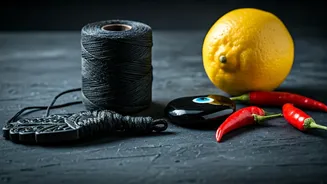
In India, a common sight outside businesses, residences, and vehicles is a lemon skewered with seven green chillies, known as nimbu-mirchi. This practice, often renewed weekly, is deeply embedded in folk beliefs as a method of protection. The prevailing idea is that the sharp, sour taste of the lemon combined with the pungent heat of the chillies effectively repels malevolent energies and ill fortune. Some folklore suggests this ritual is aimed at appeasing Alakshmi, the goddess associated with adversity, by offering her something intensely bitter and spicy to deter her from bestowing misfortune. While many today perceive this as a symbolic gesture, the tradition of replacing the nimbu-mirchi remains a widespread protective custom observed in both urban and rural areas.
Kala Dhaaga's Subtle Power
A humble black thread, known as kala dhaaga, tied around the wrist, ankle, or waist, represents one of the most understated yet potent forms of protection found in Indian households. Black is traditionally considered to possess the ability to absorb negative energies rather than reflect them back. It's common to see babies wearing these threads around their ankles for safeguarding, while adults often tie them discreetly on their wrists. Some families imbue the practice with deeper meaning by reciting a brief prayer while fastening the thread, reinforcing the protective intention behind it. This minimalist and economical practice embodies faith in its most unadorned state: quiet, deeply personal, and profoundly effective.
The Evil Eye's Shadow
The pervasive concept of the 'evil eye' has woven its way through global folklore, spiritual practices, and familial traditions for centuries. This enduring belief underscores the notion that envy itself carries a tangible weight and that deliberate actions are required for protection. Whether it's a tiny kajal dot applied to a newborn in India or a vibrant blue talisman gracing Turkish homes, humanity has consistently sought to counteract unseen negativity that could disrupt happiness, health, or prosperity. The evil eye is more than mere superstition; it mirrors a universal anxiety about external forces that threaten well-being, leading cultures to devise symbols and rituals that offer solace, bolster faith, and provide a sense of agency.
Salt's Purifying Touch
For millennia, salt has been recognized for its profound purifying properties. Within many Indian homes, it's a practice for elders to swirl a handful of salt around a person's head before discarding it, a ritual aimed at dispelling 'nazar,' or the evil eye. Additionally, some individuals place bowls of rock salt in various corners of their rooms, believing it has the capacity to absorb ambient negative vibrations. Others incorporate salt into their bathwater, seeking energetic cleansing after experiencing emotionally taxing periods. Beyond spiritual contexts, salt's symbolism extends to general cleansing and grounding, offering a tangible act that fosters a sense of renewal and peace.
Nazar Amulet's Gaze
The blue Nazar bead stands as perhaps the most universally recognized symbol dedicated to protection, with its origins tracing back to Mediterranean and Middle Eastern customs. Particularly prevalent in countries like Turkey and Greece, this amulet is characterized by its concentric circles of blue, white, and black, visually resembling an eye. The core belief is that a symbol of an eye possesses the power to deflect harmful glances, sending them back to their source. In India, it's frequently pinned onto the clothing of newborns, hung in vehicles, or fashioned into bracelets and necklaces. Many households position a Nazar near their main entrance to safeguard their homes from intrusive energies. More than just a superstition, the Nazar serves as a psychological barrier, a visible declaration of preparedness and defense.