






Zircon: Earth's Ancient Gem
Imagine holding a piece of history! Zircon isn't just any gemstone; it's a natural marvel, pulled directly from the earth, with some specimens boasting
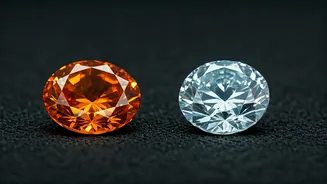
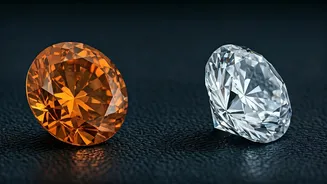
an age of over four billion years. Chemically identified as zirconium silicate, zircon captivates with its impressive ability to refract light, creating a dazzling sparkle reminiscent of diamonds. A truly unique characteristic of zircon is its double refraction: when light passes through, it splits into two rays, often making the back facets appear doubled. While its colorless form is a popular diamond substitute, zircon also occurs naturally in a spectrum of warm, earthy hues like yellow, brown, and red. Furthermore, with heat treatment, it can transform into a stunning blue. However, zircon is not as robust as some other gems, registering a 6.5 to 7.5 on the Mohs hardness scale, which means it can be susceptible to chipping if subjected to hard impact.
American Diamond: Lab-Created Brilliance
In India, the term 'American diamond' commonly refers to cubic zirconia (CZ), a meticulously crafted stone born in laboratories, designed specifically to mimic the appearance of a natural diamond. Unlike zircon, CZ has no ties to the geological world. It's produced from zirconium dioxide under precisely controlled environmental conditions. This manufactured precision ensures that cubic zirconia is almost invariably flawless, devoid of any internal inclusions or surface blemishes. Its interaction with light is also distinct; American diamonds exhibit single refraction, producing a sharp, clean sparkle. They are also celebrated for their pronounced 'fire' – the vibrant rainbow-like flashes that shimmer when light strikes them, sometimes even more intensely than a real diamond. Crucially, cubic zirconia boasts superior durability, ranking between 8 and 8.5 on the Mohs hardness scale, making it more resilient for daily wear than zircon. Its widespread appeal is further cemented by its affordability, a direct result of its mass production, solidifying its position as a dominant choice in imitation jewelry.
Distinct Origins, Different Sparkle
The allure of both zircon and American diamond often leads to their conflation, yet their origins and fundamental characteristics set them worlds apart. While both are celebrated for their diamond-like sparkle and accessibility compared to genuine diamonds, their similarities essentially end there. They originate from entirely different sources – one from deep within the Earth and the other from scientific innovation. Their chemical compositions are not alike, and their behavior when interacting with light differs significantly. Understanding these core distinctions is crucial for any consumer looking to make an informed purchase. The term 'American diamond' typically refers to cubic zirconia, a lab-synthesized gemstone created from zirconium dioxide. This man-made stone is known for its consistent flawlessness and impressive refractive properties. Zircon, on the other hand, is a naturally occurring mineral, zirconium silicate, which can contain inclusions and exhibits a different optical phenomenon known as double refraction, where light rays split within the stone, sometimes causing facet doubling.