





Lunar Seismology's New Tool
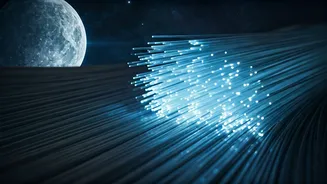
A groundbreaking proposal from Los Alamos National Laboratory researchers suggests that fiber-optic cables, commonly used for internet communication, could
become the next frontier in detecting moonquakes. The concept involves unspooling these cables across vast lunar distances. Initial lab tests, simulating the moon's surface with crushed basalt, indicate that these cables might not even require burial to effectively capture seismic signals. Beyond their sensing capabilities, these same deployed cables could simultaneously support communication infrastructure for future lunar missions, offering a dual-purpose technological advantage. This innovation promises a more comprehensive approach to understanding the Moon's geological processes, moving beyond traditional, localized seismic monitoring methods.
Moonquakes vs. Earthquakes
Unlike Earth, which experiences earthquakes primarily due to the movement of tectonic plates along fault lines, the Moon's seismic activity is driven by different forces. These lunar tremors, or moonquakes, are largely triggered by the gravitational tug of Earth and the impacts of meteorites. Furthermore, the Moon's extreme temperature fluctuations play a significant role. Its surface can plummet to below -410 degrees Fahrenheit during the lunar night and soar to 250 degrees Fahrenheit during the day. This dramatic expansion and contraction of the lunar surface contribute to its seismic instability. Understanding the waves generated by these unique triggers is crucial for unlocking secrets about the Moon's internal structure, density, composition, and even the presence of a liquid core.
A World of Sensing Cables
The application of internet cables as seismic sensors is already a reality on Earth, spanning both land and undersea environments. Millions of miles of fiber-optic cable crisscross the globe, with approximately 920,000 miles laid on the ocean floor. As older cables are retired and new ones installed, scientists are increasingly leveraging this extensive network to monitor natural hazards like earthquakes, volcanic activity, and floods. This is made possible by Distributed Acoustic Sensing (DAS), a technology that uses laser pulses to detect minute changes in vibrations and strain. Unlike traditional seismometers, which measure ground motion at a single point, a fiber-optic cable can act as a continuous sensor over a much larger area, delivering real-time, high-resolution data, revolutionizing hazard detection and response.
DAS: Precision and Cost-Effectiveness
The power of DAS technology has been vividly demonstrated by its ability to track hazards beyond just earthquakes, as seen during Iceland's volcanic eruption. The system provided a 26-minute warning before the Grindavík eruption, allowing for timely evacuation. Caltech researchers further highlighted its effectiveness by tapping into a 62-mile fiber-optic cable section and collecting data equivalent to that of 10,000 traditional seismometers. This approach offers a significantly more cost-effective seismic monitoring solution compared to traditional methods. For instance, California's more than 700 seismometers each cost up to $50,000, whereas a DAS system requires a single $200,000 interrogator for miles of cable. This cost-effectiveness is particularly valuable for underwater seismic monitoring, which is notoriously expensive and challenging. In the Canary Islands, a submarine telecommunications cable was transformed into 11,968 strain sensors, detecting local and regional earthquakes, as well as seismic waves from oceanic quakes thousands of miles away.