





Lunar Spectacle Approaches
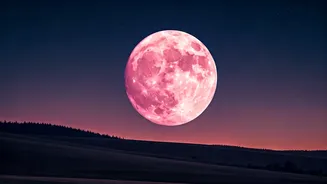
The skygazers' calendar is marked for an exciting event: the first full moon of spring is about to adorn the night sky. Traditionally referred to as the 'Pink
Moon,' this significant lunar phase is scheduled to reach its zenith of brightness in the early hours of Thursday, April 2nd. However, for the most visually striking and photographable perspectives, observers are advised to turn their attention to the preceding evening, Wednesday, April 1st, as the moon begins its ascent above the horizon. This annual occurrence is not just a treat for the eyes but also serves as a key marker for determining the dates of other significant celebrations, notably Easter and Passover, anchoring its importance in both the astronomical and cultural spheres.
Unveiling the Pink Moon
Contrary to its evocative name, the April full moon is not expected to manifest in shades of pink. The moniker 'Pink Moon' originates from ancient traditions, specifically from Native American tribes in the northern hemisphere who used lunar cycles to track seasonal changes. They associated this particular full moon with the vibrant pink wildflowers, such as wild ground phlox, that bloom prolifically at the dawn of spring. Therefore, when you look up on the evening of April 1st, anticipate a breathtaking display of oranges, coppers, and deep golden yellows, rather than a rosy hue. This intriguing naming convention highlights a rich historical connection between celestial events and the natural world.
The Science of Color
The captivating orange or golden appearance of the moon when it is low on the horizon is a result of atmospheric optics. As moonlight travels a longer path through Earth's atmosphere to reach our eyes, shorter wavelengths of light, like blues and violets, are dispersed by atmospheric particles. The longer wavelengths, encompassing reds, oranges, and yellows, are less affected and thus penetrate the atmosphere more effectively. This phenomenon is analogous to the reason we witness vibrant red and orange hues during sunsets. The denser the atmosphere and the more particles present, the more pronounced this scattering effect becomes, transforming the moon's typical silvery glow into a warm, fiery radiance.
Celestial Companion: Spica
Adding to the allure of the April full moon, astronomers have an additional treat to observe. Nestled close to the luminous moon will be an exceptionally bright point of light, easily distinguishable from its stellar neighbors. This is not merely a star but Spica, a prominent binary star system situated within the Virgo constellation. The proximity of such a dazzling celestial object to the full moon creates a particularly dynamic and visually arresting tableau in the night sky, offering a dual spectacle for those who take the time to observe. It’s a chance to witness two significant astronomical features in close conjunction.
Holiday Calendar Marker
Beyond its aesthetic appeal, the April full moon plays a crucial role in determining the dates for two major religious observances: Easter and Passover. The calculation for Easter is an ancient one, stipulating that it falls on the first Sunday following the first full moon that occurs after the spring equinox. Given that the astronomical spring equinox this year was on March 20th, the April full moon officially dictates the timing of the upcoming Easter celebrations. This connection underscores the moon's historical significance as a natural calendar and its integral role in cultural and religious traditions across millennia.
Weather Watch
As with any outdoor astronomical event, the visibility of the Pink Moon is subject to meteorological conditions. For observers in the UK, the forecast presents a varied picture. Those in England and Wales might contend with challenging viewing conditions due to expected heavy cloud cover and intermittent rain on Wednesday evening, potentially obscuring the moon. Conversely, Scotland and Northern Ireland are anticipated to experience clearer skies under colder air masses, offering a higher probability of unobstructed viewing. Regardless of perfect clarity, taking a moment to step outside on Wednesday night is encouraged to witness the transition of the spring sky.