


The Ghee-Centric Delight
At its heart, Mysore Pak is a testament to the magic that can be created with a few fundamental ingredients. This celebrated South Indian confection primarily
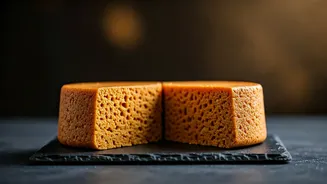
consists of gram flour (besan), sugar, and a generous, perhaps even audacious, quantity of ghee. When prepared with expertise, these components meld into a delightful fudgy block, possessing a porous texture. While its appearance might resemble a dense barfi, its texture and flavour profile are more akin to a buttery cookie that dissolves on the tongue, leaving behind a rich, nutty sweetness. The term 'pak' itself originates from 'paaka,' referring to the sugar syrup that acts as the binder for the ingredients. Traditional preparations often yield a slightly firmer, crumbly sweet. However, modern interpretations, particularly those popularized by esteemed sweet shops in Karnataka, offer a softer, melt-in-your-mouth experience that is almost airy. Regardless of its texture, Mysore Pak unequivocally delivers a decadent taste of pure ghee and slow-cooked perfection, eschewing subtlety for a bold, delicious statement.
Beyond Festival Fills
Mysore Pak transcends its role as a mere festive sweet, occupying a vital space in South Indian culinary traditions. It is almost an indispensable part of significant life events such as weddings, baby showers, and various religious observances. A celebratory spread of sweets is often deemed incomplete without the presence of these golden rectangles, often referred to as 'ghee bombs.' In many households, it is among the very first 'special' sweets considered when marking joyous occasions or aiming to impress guests. Furthermore, its historical connection to royalty has elevated it to the status of an edible heritage symbol. Food connoisseurs frequently cite Mysore Pak as a signature dessert of Karnataka, integral to the state's culinary identity, alongside other iconic dishes. Travel features often spotlight establishments dedicated to Mysore Pak, even positioning the sweet itself as a tangible piece of living history, worthy of a visit.
A Royal Culinary Accident
The most widely accepted narrative surrounding the creation of Mysore Pak points to the royal kitchens of the Wadiyar rulers in Mysore, dating back to the late 19th or early 20th century. The sweet is attributed to Kakasura Madappa, a cook in the palace. The story goes that on a particular day, when dessert preparations were lagging and the king was nearing his meal, Madappa improvised. He combined besan cooked in ghee with a hot sugar syrup, pouring the mixture onto a plate with the hope it would set. Upon tasting it, the king, reportedly Krishna Raja Wadiyar IV, was delighted by its melt-in-the-mouth quality. When asked its name, the flustered cook is said to have responded 'Mysore Paka,' signifying its origin in Mysore and the use of sugar syrup. This origin story, coupled with the king's endorsement, cemented Mysore Pak's place as a royal dessert. Madappa was later encouraged by the king to sell his creation beyond the palace, leading to the establishment of Guru Sweets, a shop still run by his descendants and revered for authentic palace-style Mysore Pak.
Variations on a Theme
Across Karnataka and its neighboring regions, Mysore Pak has evolved into several distinct styles, each offering a unique sensory experience. The 'Traditional/Firm Mysore Pak,' often associated with historic establishments like Guru Sweets, is characterized by its slightly harder texture, a distinct bite, and a porous, almost honeycomb-like interior before it melts. In contrast, the 'Soft Mysore Pak,' which has gained considerable popularity through modern sweet chains, features a higher proportion of ghee and a shorter cooking time. This results in a lighter hue and an exceptionally soft consistency, often likened to a ghee-infused sponge. Beyond these core variations, contemporary cooks and some brands have introduced 'Flavoured versions,' incorporating ingredients like cardamom, saffron, dried fruits, and even more unconventional additions such as chocolate and coffee. However, a significant contingent of purists remains steadfastly loyal to the original, unadulterated blend of besan and ghee, believing it to be the ultimate expression of this classic sweet.
The Crowned Confection
While numerous Indian sweets might hold informal claims to prestigious titles, when the designation of 'King of Sweets' is mentioned in general knowledge or trivia contexts, it almost invariably refers to Mysore Pak. This affectionate title is not merely poetic; it is frequently cited in informational explainers and quiz preparation materials, directly identifying Mysore Pak as the 'King of Sweets.' The rationale behind this esteemed title is multi-faceted, encompassing its rich royal lineage, its intensely indulgent flavour profile, and its widespread recognition and popularity across India. The moniker encapsulates the dessert's powerful association with luxury, elevated status, and the spirit of celebration that defines Indian festivities. It is a recognition of how profoundly this single dessert has captured the imagination and palate of the nation, solidifying its regal standing in the pantheon of Indian sweets.