







A New Era of Charging
The conventional trade-off between battery capacity and charging time is a long-standing limitation, impacting everything from smartphones to electric
vehicles. However, a pioneering team of Australian researchers, collaborating from CSIRO, RMIT University, and the University of Melbourne, has unveiled a revolutionary prototype that shatters this paradigm. They have successfully developed the world's inaugural functional quantum battery, a device that operates not on chemical reactions, but on the principles of quantum mechanics. This breakthrough, detailed in the publication Nature Light: Science & Applications, presents a tangible device capable of charging, storing, and discharging energy at speeds and durations previously confined to theoretical speculation. The implications for energy storage technology are profound, suggesting a future where charging waits are virtually eliminated and stored energy remains stable for extended periods.
Femtosecond Charge, Nanosecond Hold
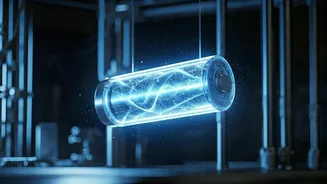
This novel quantum battery prototype is a marvel of nanoscale engineering, constructed from an organic layered wafer akin to a microscopic sandwich. Its charging mechanism is remarkably swift, utilizing a wireless laser pulse that lasts a mere femtosecond – a quadrillionth of a second. Following this incredibly brief charging period, the device demonstrates an astonishing ability to retain its energy for nanoseconds. While this duration might seem short, the true magic lies in its scalability. Lead researcher James Quach highlights that if this technology were scaled to everyday applications, a one-minute charge could theoretically translate to power retention lasting up to two years. The fundamental physics underpinning this phenomenon are now proven, with the ongoing challenge focusing on extending this stored energy's longevity in practical, real-world devices. The contrast with current battery technology, which requires substantial time to charge and often experiences self-discharge, is immense.
The Power of Superabsorption
What truly sets quantum batteries apart is their counterintuitive scaling behavior. Unlike conventional batteries, which become slower to charge as their capacity increases, quantum batteries exhibit the opposite tendency. The more molecules are integrated into the device, the faster each individual molecule charges. This phenomenon occurs because, at the quantum level, these molecules do not operate independently but rather as a cohesive unit. They engage in a collective process known as 'superabsorption,' where incoming energy is shared and absorbed in a single, synchronized burst. Specifically, the charging time decreases proportionally to the square root of the number of molecules (1/√N). This means doubling the battery size theoretically cuts charging time by nearly half. This fundamental quantum effect, mathematically predicted since 2013, offers a stark contrast to current battery limitations.
From Theory to Reality
The successful demonstration of a complete energy cycle—charging, storing, and crucially, discharging the energy as usable electrical current—marks a significant advancement. While a partial version of this quantum effect was observed in 2022, the current prototype achieves the full functional cycle, a feat not accomplished in previous quantum battery experiments. Furthermore, a key practical advantage is that this device operates at room temperature. This contrasts sharply with some competing quantum battery approaches developed in China and Spain, which necessitate cryogenic cooling, adding significant complexity and cost. The ability to function without extreme temperatures makes this Australian prototype far more amenable to real-world integration and commercialization.
Future Applications and Potential
While the current quantum battery prototype's energy capacity is minuscule, measured in billionths of electron-volts, rendering it insufficient for immediate use in devices like electric vehicles, its potential for other advanced technologies is immense. Quantum computers, which are highly sensitive to power disruptions and require coherent energy delivery without electrical noise, represent a prime candidate for this technology. Quantum batteries naturally communicate in the same 'quantum language' that these processors understand, offering a way to provide energy coherently with minimal energy cost. Experts suggest that such batteries could revolutionize quantum computing by supplying stable, noise-free power. CSIRO is actively seeking development partners, including automotive manufacturers and venture capitalists, to accelerate the transition from this foundational research to practical applications.