






Vision for Lunar Expansion
NASA envisions an unprecedented lunar outpost, sprawling across hundreds of square miles, as part of the Artemis program's ultimate goal of establishing
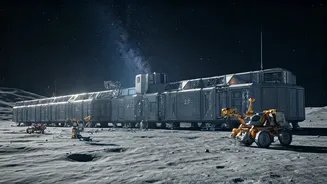
a permanent human presence on the Moon. This expansive development isn't a singular, concentrated point but rather a distributed network, akin to a city, designed to accommodate diverse needs. The base's considerable footprint arises from the necessity to integrate various critical components, such as habitats strategically placed on elevated terrain for sunlight access, and power systems like nuclear reactors positioned at least a kilometer away to mitigate radiation hazards. Furthermore, the inherent unknowns about the lunar south pole, the chosen location for the base due to its potential water ice reserves, necessitate a broad exploration strategy. Planners acknowledge that maximizing scientific objectives and ensuring the viability of a lasting settlement requires surveying multiple distinct sites. This deliberate expansion reflects a pragmatic approach to lunar habitation, acknowledging the complexities of the environment and the varied requirements for sustainable living and operation far from Earth. The scale is a natural outcome of bringing together all the envisioned elements, rather than an initial design constraint.
Advanced Mobility and Scouting
To facilitate this extensive lunar settlement and exploration, NASA is deploying sophisticated robotic assets. Hopping drones, such as those in the MoonFall project, will play a crucial role in the initial scouting and mapping of the lunar south polar region, preceding any construction efforts. These agile robots are designed to mark the boundaries of designated areas, particularly those of scientific importance or intended for base development. Beyond these drones, large lunar terrain vehicles (LTVs) are being developed by companies like Astrolab and Lunar Outpost, with contracts totaling hundreds of millions of dollars awarded for their production. These LTVs are more than just transportation; they are capable of autonomous operation, allowing them to land and potentially operate remotely from Earth before astronauts arrive, eventually meeting them at their landing zones. The plan is to have at least one LTV on the lunar surface by the time of the Artemis 4 mission in late 2028, underscoring the importance of advanced mobility for both exploration and infrastructure development in this new lunar frontier.
Phased Construction and Contracts
The ambitious Artemis moon base project will unfold over a series of carefully planned phases. Phase One, spanning from the present through 2029, focuses on gathering in-depth information and securing reliable access to the lunar surface. This foundational period is crucial for understanding the environment and establishing initial logistical pathways. Following this, Phase Two, scheduled from 2029 to 2032, will concentrate on establishing the base's "initial operating capability." This signifies the point at which the base can begin to function in a limited capacity, supporting basic operations. The ultimate goal is represented by Phase Three, commencing in 2032 and extending into the distant future, which aims to "achieve semi-permanent crew presence" on the Moon. This multi-stage approach ensures systematic progress, allowing NASA and its partners to learn and adapt as they build. The development is supported by significant contracts awarded to private companies. For instance, Blue Origin is contracted to deliver two LTVs via its Blue Moon lander for $234 million each. Firefly Aerospace is also involved, having secured a $75 million contract for delivering the first batch of MoonFall drones in 2028.
Strategic Importance and Future Missions
The establishment of an American moon base is underpinned by significant strategic considerations, including a desire to lead in setting norms for responsible behavior on the lunar surface. NASA Administrator Jared Isaacman emphasized the importance of being the first to establish a presence, stating, "I think it's important for us to get there first." This competitive aspect is further highlighted by China's own lunar base ambitions, with a target astronaut landing by 2030. NASA intends to operate within the framework of the Outer Space Treaty, ensuring respect for other nations' lunar assets and expecting reciprocity. The Artemis program itself is progressing steadily, with Artemis 1 successfully sending an uncrewed Orion capsule to lunar orbit and back in late 2022, and Artemis 2 completing a crewed lunar flyby last month. Upcoming missions include Artemis 3, slated for mid-2027, which will involve a docking test in Earth orbit between the Orion capsule and privately developed lunar landers, such as Blue Origin's Blue Moon and SpaceX's Starship. This series of missions builds toward the larger objective of enabling sustained human activity and establishing a permanent foothold beyond Earth.