







Future of Flight
The dream of zipping across the vast Pacific Ocean in less time than a short domestic flight is inching closer to reality, thanks to pioneering work by
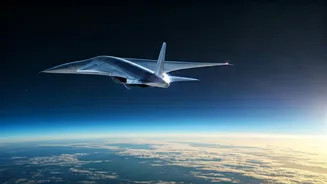
Japan's Aerospace Exploration Agency (JAXA) and several leading universities. Through rigorous ground tests, a team from JAXA, Waseda University, the University of Tokyo, and Keio University has successfully validated a ramjet engine designed for Mach-5 hypersonic aircraft. This significant milestone paves the way for future flights, potentially reducing the Tokyo to Los Angeles journey to a mere two hours. The experiments, conducted at JAXA's Kakuda Space Center, focused on simulating flight conditions at five times the speed of sound to test critical systems like heat shielding, control surfaces, and the engine's performance under extreme stress. Alongside similar hypersonic research in the U.S., like NASA's X-59, these developments are poised to redefine our understanding of high-altitude, high-speed passenger and even suborbital transportation possibilities.
Ramjet Engine Mechanics
At the heart of this revolutionary propulsion system lies the ramjet, a fascinating type of air-breathing jet engine that notably lacks any moving parts. Its operation relies on the aircraft's own immense forward velocity to 'ram' air into the engine. This compressed air is then expertly mixed with fuel and ignited, generating the powerful thrust required for hypersonic flight. This ingenious design bypasses the need for heavy, rotating compressors found in conventional jet engines, allowing for speeds far exceeding current commercial aircraft capabilities. However, a crucial limitation of ramjets is their inability to function from a standstill; they must first be propelled to supersonic speeds by another means before they can operate effectively. In Japan's experimental setup, the prototype aircraft was secured within a wind tunnel, simulating the rarefied atmospheric conditions at an altitude of approximately 25 kilometers. At this height, where the air density is a mere one-hundredth of that at sea level, and at Mach-5, the air encountering the aircraft's nose and leading edges can reach scorching temperatures exceeding 1,000 degrees Celsius (1,832°F). This intense heat presents a formidable engineering challenge, one that even the U.S. Air Force has grappled with in its own hypersonic endeavors.
Thermal Defense Systems
To combat the extreme thermal loads encountered during hypersonic flight, the engineering team developed a sophisticated thermal-protection system. This advanced shielding was meticulously designed to maintain the aircraft's internal environment at near-normal operating temperatures, ensuring the crucial onboard avionics and control electronics could function flawlessly. Concurrently, an array of sensors meticulously mapped the surface temperature distribution across the aircraft. This data was vital for verifying the accuracy of thermal-structure calculations, an absolutely essential step for successfully scaling the technology up to a full-sized passenger vehicle. The ability to withstand and manage such intense heat is paramount for the viability of hypersonic travel, as it directly impacts the safety and reliability of the aircraft and its systems. Without robust thermal management, the extreme temperatures could lead to catastrophic failures, rendering hypersonic passenger flights an impossibility.
Path to Hypersonic Travel
While this initial ground test represents a significant validation of a scaled-down ramjet model, it's important to note that it's still a considerable distance from an actual flight. The next critical phase for JAXA involves mounting this experimental vehicle onto a sounding rocket. Sounding rockets, typically employed for scientific measurements and experiments in near-space environments, will be used to attempt a genuine Mach-5 flight. Should this test prove successful, and assuming that both regulatory approvals and further technical challenges can be successfully navigated, the ambitious goal is to introduce commercial hypersonic passenger services by the 2040s. The realization of this vision would dramatically alter global travel dynamics. A Mach-5 aircraft, operating at an altitude of 25 kilometers – nearly double that of current commercial airliners – could theoretically slash the travel time from Tokyo to Los Angeles from the current approximate 10 hours down to a remarkable two hours. This dramatic reduction in transit time would transform long-haul international journeys, turning what was once a significant time commitment into a brief, manageable flight. The implications for business, tourism, and global connectivity are profound, potentially making intercontinental travel as convenient as domestic hops.