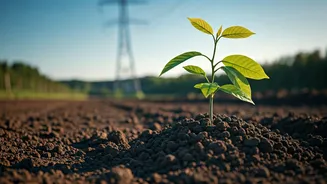







Feasibility and Key Concerns
It is indeed possible to plant trees in proximity to power lines, a fact confirmed by arborists and landscaping professionals. However, this endeavor is not
without its critical considerations. The primary challenge stems from the tree's ultimate mature size, which can significantly impact its relationship with the overhead infrastructure. Homeowners must be vigilant about potential issues that arise years down the line when a seemingly small sapling matures into a substantial tree. Ignoring these long-term implications can lead to significant problems, including damage to the tree itself or, in unfortunate scenarios, its complete removal. Utility companies often intervene to prune trees that interfere with power lines, a process that can be detrimental to the tree's health and structure if not handled with care. Therefore, meticulous planning and understanding of these factors are paramount for successful tree planting near power corridors.
Legal and Locational Rules
Navigating the legal landscape is the first crucial step. Local ordinances and utility company regulations dictate precisely where and what kind of trees can be planted near power lines. Homeowners are strongly advised to consult with their city, county, or state authorities, as well as the local power provider, before making any planting decisions. Easements, which grant utility companies the right to access and manage areas for their infrastructure, play a significant role. Peter Lowe, Garden Program Manager at The Dawes Arboretum, highlights that these easements can sometimes result in less-than-ideal pruning practices by the power company. Such interventions might harm the tree's health, compromise its structural integrity, or even necessitate its removal. Beyond legalities, careful consideration of the tree's mature dimensions—both height and width—is vital. Scott Seargeant, owner of Seargeant Landscape & Arboriculture, emphasizes the importance of 'looking up, down, and all around' before selecting a planting spot to anticipate future growth and potential conflicts.
Tree Dimensions and Species
When considering tree placement near power lines, prospective planters must meticulously assess the tree's eventual height and spread. Scott Seargeant recommends that a tree's mature height should not exceed 75% of the height of the lowest power line. To ensure ample clearance and preempt future issues, Peter Lowe suggests a maximum mature height of 15 feet, with a flexible upper limit of 20 feet if no other options are available. The tree's canopy width is also a significant factor, especially for trees planted near property lines, requiring several feet of buffer space to avoid encroaching on power lines and neighboring properties. Lowe advises planting trees at least 40 to 50 feet away from power lines. For an added layer of safety, professionals suggest using the property line as a measurement point rather than the power line itself. To minimize potential conflicts, it's best to opt for smaller ornamental trees or slow-growing species. Recommended species include American Fringetree, American Hornbeam, Crape Myrtles, Dogwoods, Eastern Redbud, Flowering Dogwood, Magnolia, Red Buckeye, Redbuds, and Serviceberry.
Effective Pruning Strategies
While selecting appropriate tree species and planting locations are essential, professional pruning remains a cornerstone of managing trees near power lines. Arborists stress that plants are remarkably resilient to proper pruning techniques. Jack Hamer, Managing Director of Silvermere Landscapes, advises against attempting to work near live cables due to extreme danger, emphasizing that such tasks should only be performed by qualified professionals. Peter Lowe highlights that winter is the optimal time for pruning, allowing trees ample time to recover from any wounds. A crucial technique to avoid is 'topping,' which involves removing the majority of the tree's leafy canopy; this method is detrimental to the tree's long-term health. Instead, professionals advocate for 'crown reduction,' a selective pruning method that lowers the tree's height by cutting back to lateral branches. Regular pruning by a certified local arborist on a scheduled basis is recommended. Pruning should also be done with specific goals in mind, such as enhancing flowering, promoting fruit production, correcting damage, or addressing poor growth patterns, ensuring the tree remains healthy and aesthetically pleasing.












![[WATCH] 'Real Madrid, Ramadan and rest' - Mohammed Siraj how last-minute World Cup call-up changed February plan](https://g-mob.glance-cdn.com/public/fc/image/ByYT_LEmlrD0.webp)
