







Power Consumption Deep Dive
When the mercury climbs to a blistering 45°C in India, staying cool often means choosing between immediate comfort and long-term expenses. Understanding
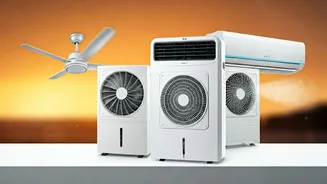
how much power each cooling appliance consumes is the first step to making an informed decision. A standard ceiling fan, typically rated around 75W, primarily circulates air without significantly altering the room's temperature. Air coolers, a popular choice in drier climates, draw between 150W to 300W, employing water evaporation to lower the temperature; their effectiveness is greatly influenced by ambient humidity. In stark contrast, a 1.5-ton inverter air conditioner is a power-hungry appliance, consuming between 1000W and 1500W. This substantial difference means ACs can use five to ten times more electricity than air coolers, and considerably more than even the most robust fans, directly impacting your monthly utility bills.
Monthly Cost Breakdown
To truly grasp the financial impact of staying cool during intense heatwaves, let's examine the monthly electricity expenses for each appliance, assuming an average tariff of ₹7 per unit and 8 hours of daily operation in a city like Delhi experiencing 45°C heat. A simple ceiling fan, with its low power draw, incurs a minimal cost of approximately ₹0.5 per hour, translating to a monthly bill of around ₹120. Air coolers, while more effective, will cost between ₹1 to ₹1.4 per hour, leading to a monthly expenditure of roughly ₹250 to ₹330. Air conditioners, however, represent a significant financial commitment. Their hourly cost can start at ₹7 and climb much higher, resulting in a monthly bill ranging from approximately ₹1,700 to ₹1,800. This stark comparison reveals that fans are the cheapest option, costing about 11 times less than an AC, while coolers offer excellent value, being approximately 7 times cheaper than an AC.
Long-Term Investment Analysis
Beyond the immediate monthly electricity bills, it's essential to consider the total cost of ownership over several years, particularly when facing extreme 45°C temperatures where reliance on cooling is high. A basic fan might cost between ₹1,500 to ₹5,000 upfront, bringing its 5-year total cost to around ₹9,000, factoring in minimal electricity usage. An air cooler, with its higher initial purchase price of ₹5,000 to ₹15,000, escalates to a 5-year total of approximately ₹25,000, accounting for its moderate electricity consumption and occasional maintenance. Air conditioners, on the other hand, demand a substantial initial investment, ranging from ₹30,000 to ₹60,000, plus installation fees. When you add regular servicing costs, which can range from ₹1,500 to ₹3,000 annually, the total cost over five years can easily exceed ₹1.5 lakh. This illustrates that ACs are considerably more expensive not only for purchase but also for ongoing upkeep.
Performance in Extreme Heat
When temperatures reach a severe 45°C, the actual performance of each cooling device becomes critically important for comfort and well-being. A traditional fan, while effective in moderate conditions, struggles significantly above 35°C; beyond this point, it essentially just circulates hot air, potentially making the environment feel even more uncomfortable. Air coolers offer a more promising solution in dry heat, capable of reducing the temperature by 5°C to 10°C through water evaporation. However, their efficiency is tied to ventilation and regular water refilling, and they perform poorly in humid conditions. Air conditioners stand out as the only appliance guaranteeing consistent cooling, maintaining temperatures between 24°C and 26°C regardless of external conditions, including high humidity. Moreover, ACs also provide dehumidification, which is a significant factor in enhancing overall comfort during sweltering heatwaves, making them a vital consideration for health and necessity.
Smart Cooling Strategies
For those seeking to mitigate the high electricity costs associated with ACs while still ensuring adequate comfort during India's intense 45°C heat, a smart hybrid approach can be highly effective. By running your air conditioner at a slightly higher temperature, such as 26°C, and simultaneously operating a ceiling fan, you can achieve substantial energy savings. This combination allows the fan to circulate the cooled air more efficiently, reducing the need for the AC to work as intensely. This strategy can cut electricity consumption by approximately 20%, leading to monthly savings of roughly ₹300 to ₹400. It offers a practical way to maintain a comfortable environment without the steep financial burden of running the AC at its lowest settings, ensuring you benefit from both cooling and cost-effectiveness.
Regional Cooling Choices
The optimal choice for cooling varies significantly depending on your geographical location and its specific climate, especially when dealing with extreme temperatures like 45°C. In cities characterized by dry heat, such as Delhi or Jaipur, air coolers emerge as the best value proposition. Their evaporative cooling mechanism is highly effective in such environments, and they are considerably cheaper to operate than air conditioners. Conversely, coastal cities like Mumbai or Chennai, which experience high humidity, render air coolers largely ineffective as they struggle to evaporate water and can even increase indoor moisture. In these humid regions, an air conditioner is the only reliable option for achieving consistent and comfortable cooling, as it not only cools the air but also effectively dehumidifies the environment, providing a crucial comfort advantage.