





Detonation Engine Breakthrough
The realm of space exploration is witnessing a significant advancement thanks to the recent achievements of Astrobotic, a private aerospace company. They
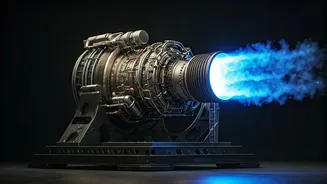
have successfully conducted a series of tests on two of their cutting-edge rotating detonation rocket engines (RDREs), pushing the boundaries of endurance. Notably, these engines sustained a continuous burn of 300 seconds, a duration that Astrobotic believes sets a new benchmark for this type of engine technology. The total test time for these two engines exceeded 470 seconds, showcasing remarkable stability and performance. This innovation brings next-generation rockets, capable of reaching destinations faster and carrying more, significantly closer to reality.
How RDREs Work
Understanding the science behind Astrobotic's success reveals a novel approach to rocket propulsion. Unlike conventional rocket engines that rely on a steady burn of propellants, RDREs utilize a different, more energetic combustion process. In traditional engines, fuel and oxidizer are introduced into a chamber, where they ignite to create exhaust gases that generate thrust. RDREs, however, employ a method where fuel is first compressed and then ignited by a supersonic shock wave. This controlled, continuous explosion, or "detonation," produces a more potent and efficient thrust. The inherent advantage of this design is its potential to propel spacecraft at higher velocities and with greater efficiency, enabling longer missions and the transport of heavier payloads, a crucial factor for deep space exploration.
Test Site and Performance
The critical test of Astrobotic's "Chakram" engines took place at the esteemed Marshall Space Flight Center, a facility within NASA's network. Footage from the event shows the twin engines igniting with a vibrant blue flame, a visual testament to the powerful forces at play. According to Bryant Avalos, Astrobotic's principal investigator for the Chakram program, the engines performed exceptionally well, surpassing initial expectations. He expressed relief and excitement, noting that moving such advanced technology from the design phase to rigorous testing always involves confronting unforeseen challenges. The fact that the engine not only functioned but exceeded performance predictions, particularly with the record-breaking 300-second burn, was a major cause for celebration and a strong indicator of RDRE viability.
Future Lunar Missions
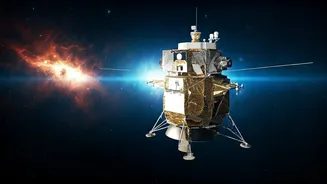
The ultimate goal for Astrobotic with this advanced engine technology is to facilitate future lunar exploration. The company envisions integrating these Chakram engines into their Griffin lunar landers, with the first Griffin mission scheduled for launch as early as July, utilizing a SpaceX Falcon Heavy rocket. This successful engine demonstration underscores the versatility of RDRE technology, which could support a multitude of Astrobotic's future endeavors. Beyond lunar landers, these engines could be adapted for various in-space applications, such as orbital transfer vehicles, thereby expanding operational capabilities within the cislunar space environment and enabling more ambitious missions.
Current Limitations and Next Steps
Despite the significant progress, Astrobotic's RDREs are not yet ready for immediate deployment on a launchpad. During the recent tests, each Chakram engine generated over 4,000 pounds of thrust. While impressive for an RDRE, this figure is considerably lower than the immense power of rockets like SpaceX's Falcon Heavy, which produces over five million pounds of thrust using 27 engines. Extensive further testing and development are necessary before these engines can be integrated into a launch system. However, the wealth of data gathered from these trials provides a strong and encouraging foundation for the company's ongoing research and development efforts.
Industry-Wide RDRE Push
Astrobotic is not the sole entity exploring the potential of rotating detonation engines. The aerospace industry is actively investigating this technology for its revolutionary benefits. For instance, Venus Aerospace has been developing its own RDRE, with applications envisioned for both rocket propulsion and advanced aircraft. This company reportedly completed the first U.S.-based flight test of an RDRE in May 2025. Furthermore, the Japan Aerospace Exploration Agency (JAXA) successfully tested an RDRE in space back in 2021, maintaining a six-second firing duration. These parallel efforts highlight a global trend towards harnessing the power and efficiency of detonation-based rocket propulsion.