



A Comet's Grand Entrance
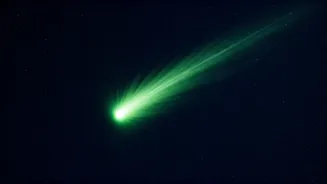
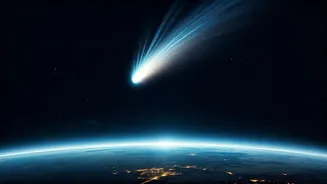
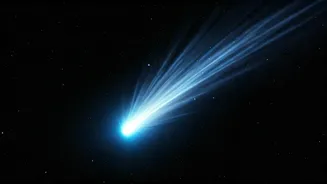
Skywatchers worldwide are buzzing about a remarkable celestial visitor, C/2026 A1, also known as MAPS. This comet, first identified on January 13, 2026,
by a team of French amateur astronomers – Alain Maury, Georges Attard, Daniel Parrott, and Florian Signoret – using telescopes in Chile, has earned its acronym from their names. What makes MAPS particularly astonishing is its classification as a Kreutz sungrazer. These comets are known for their daring trajectories, plunging incredibly close to the Sun. In fact, MAPS was the most distant sungrazer ever detected at the moment of its discovery, suggesting it might be quite a substantial celestial body. Belonging to the Kreutz family, named after German astronomer Heinrich Kreutz, these comets venture perilously near our star, a stark contrast to more conventional comets that maintain a safe orbital distance. The intense solar heat causes their icy cores to sublimate, creating dazzling displays of light and gas, often so brilliant they can be seen even during the daytime. However, this close proximity carries a significant risk, as the extreme conditions can sometimes lead to the comet's complete disintegration.
The Legacy of Sungrazers
The phenomenon of Kreutz sungrazers is rooted in a grand cosmic event from the distant past. It's believed that these comets are fragments of an enormous parent body, likely exceeding 100 kilometers in width, which made a close pass by the Sun between the 3rd and 4th centuries BCE. This colossal object eventually fractured into two major pieces and countless smaller fragments. Over the millennia, these remnants have continued their journeys, returning periodically and often achieving record-breaking brilliance. A prime example of this is the Great Comet of 1882, which achieved an astonishing brightness that was 100 times greater than that of a full Moon, dominating the night sky for several months and captivating observers across the globe. These sungrazers, therefore, are not just fleeting sights but echoes of a colossal ancient event, each one a testament to the dramatic and powerful processes at play within our solar system, offering a glimpse into cosmic history.
Viewing from India
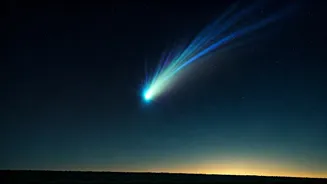
Mark your calendars for early April 2026, as comet MAPS is set to reach its perihelion – its closest approach to the Sun – on April 4–5. During this time, it will skim approximately 170,000 kilometers above the Sun's surface. Should it successfully navigate this fiery encounter without breaking apart, observers can anticipate a celestial performance comparable to the brightness of Venus. There's even a possibility of it being visible to the naked eye during the day, distinguished by a unique turquoise tail formed by exotic gases. For those in India, particularly in the southern regions, the prime viewing window will be in the southwest direction, about 30 to 45 minutes after sunset in early April. To combat the Sun's glare and enhance the view, it's advisable to use binoculars or a small telescope. Observers in northern India might face more challenges due to obstructions near the horizon. To help you track its precise location, consider using astronomy applications like Stellarium.