




Cosmic Gathering Unfolds
From April 16th to April 23rd, the Indian sky will host a remarkable celestial arrangement featuring Mercury, Mars, Saturn, and Neptune. This event presents
a limited yet captivating opportunity for stargazers to observe multiple planets grouped together in the early morning hours. To catch this astronomical marvel, one needs to be prepared to wake up before dawn. The alignment, while appearing as a close grouping from our vantage point on Earth, is purely an optical illusion. In reality, these planets are separated by vast cosmic distances, their apparent alignment stemming from their orbits around the Sun along the ecliptic plane, a shared flat trajectory.
Viewing Guide for India
Across India, this planetary alignment will be observable, assuming clear atmospheric conditions. The prime viewing window is approximately 30 minutes prior to sunrise, translating to a period between 5:00 AM and 5:45 AM, with slight variations based on specific location. Success hinges on orienting yourself towards the eastern horizon and seeking out a vantage point free from obstructions like tall buildings and excessive artificial light pollution. The most spectacular visibility is anticipated between April 18th and April 20th, when the planetary formation will be most distinct, offering a clearer spectacle for observers.
Spotting the Planets
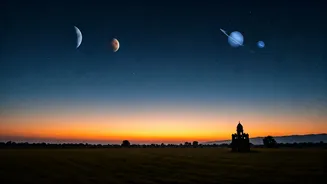
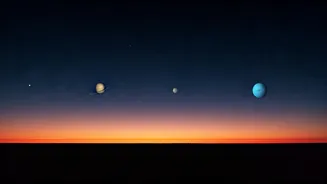
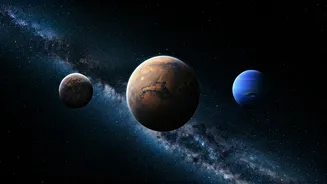
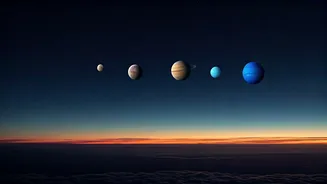
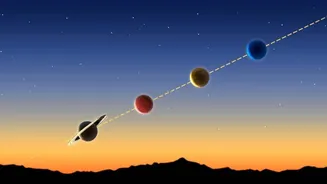
The four celestial bodies will appear at different heights above the eastern horizon, forming a discernible line. Mercury, being closest to the horizon, may prove challenging to spot due to the encroaching dawn light, though its visibility should improve as the alignment progresses towards its peak. Saturn, displaying a gentle yellowish hue, will hover slightly higher than Mercury and is typically visible to the naked eye, though binoculars will enhance the viewing experience. Mars will be more conspicuous, easily identifiable by its characteristic reddish-orange color and positioned higher in the sky. Neptune, the most elusive of the quartet, will be the faintest and will require optical aid, such as binoculars or a small telescope, for detection.
Dynamic Celestial Dance
What makes this particular alignment exceptionally fascinating is the dynamic nature of the planets' positions over the observed period. Initially, the planets might appear in a somewhat triangular configuration. However, as April 20th approaches, this arrangement will evolve into a more linear, diagonal formation. This visual progression allows observers to witness firsthand how the relative positions of these celestial wanderers shift and change over a mere span of a few days, offering a unique glimpse into planetary motion.
A Fleeting Cosmic Window
Alignments involving four planets in such a compact and clear manner are relatively uncommon. While gatherings of three planets are encountered more frequently, observing four planets simultaneously within the same celestial arc is a rarer occurrence. For those willing to embrace the early morning hours, this week-long event provides an accessible yet unforgettable opportunity to engage with the night sky. Encouragingly, for the majority of the planets, no specialized astronomical equipment is necessary, making this celestial spectacle a readily available experience for most.