
Self-Driving Rovers Unleashed
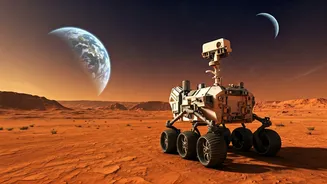
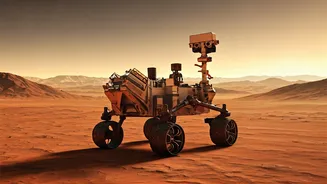
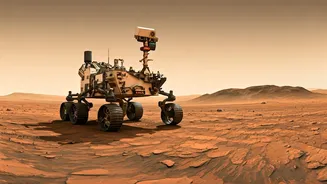
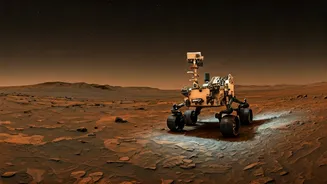
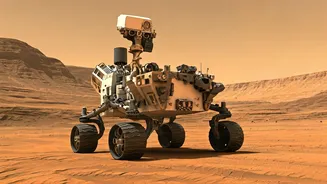
NASA's dedication to advancing Mars exploration is evident in the development of self-driving rovers. This innovative technology allows the rovers to traverse
the harsh Martian environment with enhanced autonomy. With this capability, rovers can now make decisions on their own. They can analyze the terrain, identify potential hazards like boulders or steep slopes, and chart the most efficient and safe routes. This autonomous driving capability is a significant advancement over previous generations of rovers, which relied on Earth-based controllers to send instructions, a process often limited by the time delay in communicating with Mars. The implementation of self-driving functionality permits the rovers to cover far greater distances and conduct more detailed investigations. This means more scientific data collected, accelerating our understanding of the Red Planet.
Advanced Navigation Systems
At the core of these self-driving rovers lies a sophisticated suite of technologies, including advanced navigation systems. These systems combine several crucial components to provide precise positioning and efficient route planning. They utilize stereo cameras to create three-dimensional maps of the surrounding environment, allowing the rover to 'see' the terrain in detail. These cameras are crucial, working much like human eyes to perceive depth and identify obstacles. In addition to visual data, the rovers use onboard computers and sophisticated algorithms. These systems process data rapidly, enabling the rover to make instant decisions. They also incorporate inertial measurement units, which keep track of the rover's movements and orientation, helping to maintain accuracy even when visual data is limited or obscured. The synergy of these technologies allows the rovers to navigate challenging terrains, making their journeys safer and more productive.
Benefits of Autonomy
The shift toward autonomous driving brings about a multitude of advantages for Mars exploration. First and foremost, autonomy significantly enhances the efficiency of the rovers. By eliminating the reliance on instructions from Earth, the rovers are free to explore the Martian surface at a much faster pace. Communication delays between Earth and Mars can be substantial, often taking several minutes, which delays the operations. Self-driving rovers can swiftly respond to immediate circumstances. Furthermore, autonomous driving capabilities provide rovers with an increased ability to adapt to unforeseen circumstances. Rovers can quickly adjust their routes, avoiding obstacles and changing their plans in response to unexpected geological features. This flexibility ensures that the rovers are capable of continuing their missions despite the challenges of the harsh Martian environment. Autonomous driving also reduces the workload for mission controllers, allowing them to focus on broader scientific objectives. The result is a more efficient, adaptable, and scientifically productive exploration of Mars.
Future Mission Implications
The implementation of self-driving technology has far-reaching implications for future Mars missions. The increased efficiency and adaptability of rovers will greatly extend their operational lifespan. With the ability to make their own decisions and traverse complex terrains, rovers can be deployed on longer missions, covering greater distances and gathering more data. This will provide unprecedented amounts of scientific information about Mars. Further, autonomous driving lays the groundwork for more complex missions. NASA can envision the operation of teams of rovers, each performing specialized tasks and working independently. These autonomous explorers could collaborate, sharing information and coordinating their activities to achieve scientific goals. Moreover, the technologies developed for self-driving rovers have many potential terrestrial applications. The navigation systems, sensor technology, and artificial intelligence developed for space exploration can be adapted for use in autonomous vehicles here on Earth. Thus, the advances in robotic autonomy on Mars will have positive impacts that go far beyond the red planet.