


The Growing Threat
The dream of a pristine, star-filled night sky is increasingly under siege. While light pollution has long been a concern for astronomers and stargazers,
a new, more pervasive threat is emerging from above: satellites. With ambitious plans to launch nearly a million artificial objects into orbit, the sheer volume of these man-made celestial bodies could soon dwarf the twinkling stars we’ve long admired. This potential saturation isn't just a minor inconvenience; it poses a significant risk to astronomical research and the very experience of observing the universe from Earth. As organizations dedicated to preserving dark skies work to mitigate light pollution, the overwhelming presence of satellites presents a fresh and urgent challenge that requires immediate attention and consideration from regulatory bodies and the public alike.
Satellite Swarm's Impact
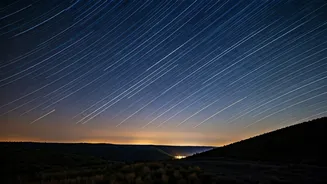
The sheer number of satellites in orbit is already noticeable, with over 10,000 currently circling Earth. However, a proposal for the deployment of one million additional satellites, some of which are intended to function as data centers for AI computing, promises to fundamentally alter our celestial panorama. Research from 2021 indicated that with just 65,000 satellites, one in every 15 visible points of light would be an artificial object, not a star. Projecting this forward, a million satellites would mean artificial objects would overwhelmingly outnumber the stars visible to the human eye, which are fewer than 4,500 in an unpolluted sky. This scenario would severely diminish the night sky experience globally, impacting not only professional astronomy but also casual stargazing and even tourism focused on dark sky destinations.
Beyond Stargazing Concerns
The implications of a sky crowded with over a million satellites extend beyond the visual obstruction of stars. The increased density of objects in Earth's orbit raises the specter of a heightened risk of collisions, which could trigger cascading debris events, creating a hazardous environment for all space-faring activities. Furthermore, some scientific reports suggest that such a massive constellation of satellites could have unpredictable effects on Earth's climate. These potential environmental and safety concerns, coupled with the devastating impact on astronomical observation, highlight the critical need for careful consideration and regulation by bodies like the Federal Communications Commission (FCC) as they review proposals for these mega-satellite constellations.