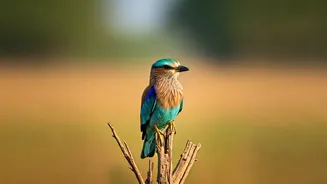









The Melodious Asian Koel
The Indian summer brings with it the unmistakable serenade of the Asian Koel, a bird instantly recognizable by its distinctive "koo-ooo" call. This common
summer visitor exhibits a fascinating sexual dimorphism: the males are adorned in a glossy, jet-black plumage, while the females present a more subdued yet equally attractive brown hue, marked with fine white streaks. Their activity levels tend to be at their peak during the breeding season, making their presence particularly noticeable across various Indian landscapes. Observing them requires a keen ear for their melodious calls that cut through the summer air, and a sharp eye to spot their quick movements amongst the foliage. These birds are a testament to the vibrant life that thrives even under the harshest summer sun, adding an auditory and visual dimension to the season.
Nocturnal Black-crowned Night Heron
Venturing from the cooler climes of Europe and Western Asia, the Black-crowned Night Heron makes its way to India during the summer. These fascinating birds have a predilection for wetland habitats, where they can find an abundance of their preferred diet, which primarily consists of fish and other aquatic organisms. Their active hours are typically confined to the twilight and nighttime, a behaviour that allows them to hunt effectively under the cover of darkness. While they may be less visible during daylight, their presence significantly contributes to the biodiversity of India's marshlands and riverbanks. Their slightly stocky build and dark plumage make them a stealthy hunter of the night, an integral part of the aquatic ecosystem.
Striking Blue-cheeked Bee-eater
A visually arresting species, the Blue-cheeked Bee-eater captivates with its distinct aesthetic. Closely related to the Blue-tailed Bee-eater, this bird is easily identified by the prominent patch of brilliant blue adorning its cheeks, a striking contrast against its other colourful plumage. Complementing this feature is a finely curved bill, perfectly adapted for its insectivorous diet. Much of its sustenance comes from hunting insects, with a particular fondness for bees and dragonflies, which it expertly snatches mid-air. Its vibrant appearance and agile hunting style make it a delightful subject for birdwatchers and a vital component of insect population control in its habitat.
Vibrant Blue-tailed Bee-eater
Migrating from the lush regions of Southeast Asia, the Blue-tailed Bee-eater is a spectacle of colour that graces Indian skies during the summer. These birds are frequently observed congregating near bodies of water, their vibrant plumage a dazzling sight against the blue of the sky or water. Their name hints at their primary activity: expertly catching insects, especially bees, while in flight. Witnessing their aerial acrobatics as they dart and weave to capture prey is a truly mesmerizing experience, showcasing their exceptional agility and hunting prowess. Their presence adds a lively splash of colour and dynamic action to the summer landscape, a true joy for any observer.
Unique Comb Duck Visitor
Adding to the diversity of India's waterfowl population during the summer months is the Comb Duck, also locally known as "Natka." This distinctive duck is easily identified by a peculiar, cartilaginous knob that protrudes from the base of its bill, a feature that sets it apart from other duck species. The Comb Duck arrives in various parts of India specifically for its breeding season, seeking out the tranquil environments of marshes and wetlands. These waterlogged areas provide the ideal conditions for nesting and foraging. Its unusual physical characteristic and its choice of habitat make it a particularly interesting species to observe, contributing a unique element to India's summer avian fauna.
Resplendent Eurasian Golden Oriole
A breathtaking sight and a delightful sound, the Eurasian Golden Oriole is a celebrated summer migrant to India. This bird is characterized by its stunning, radiant yellow plumage, which makes it remarkably conspicuous, especially when perched against the green backdrop of its preferred habitats. Its presence is further announced by its melodious, whistling call, a sweet sound that resonates through forests and open woodlands. Having journeyed from the diverse landscapes of Europe and Africa, these orioles thrive in environments that offer both cover and open spaces for foraging. Their vibrant colouration and enchanting song make them a sought-after species for bird enthusiasts during the summer season.