




Cosmic Bright Lights
For decades, astronomers have been captivated by core-collapse supernovas, the dramatic endpoints for massive stars. While around 400 of these events have been cataloged,
a select few stand out due to their extraordinary brilliance, earning them the moniker "superluminous." These celestial fireworks can outshine typical supernovas by a factor of ten or more in visible light, prompting intense scientific curiosity about the underlying mechanisms that fuel such incredible displays of energy. Understanding these phenomena is crucial for unraveling the life cycles of stars and the fundamental physics of extreme cosmic environments, pushing the boundaries of our knowledge about the universe.
Gamma-Ray Discovery
In 2024, a significant breakthrough occurred when scientists utilized NASA's Fermi Gamma-ray Space Telescope to detect the most energetic form of light, gamma-rays, emanating from a spectacularly bright supernova designated SN 2017egm. This colossal stellar explosion occurred approximately 440 million light-years away in the galaxy NGC 3191. Despite the vast cosmic distance, the gamma-ray signal's arrival marked it as one of the closest core-collapse supernovas ever observed to Earth, providing an unprecedented opportunity for study. Researchers specifically targeted the six nearest superluminous supernovas observed over Fermi's initial 16 years, and SN 2017egm was the only one to yield a definitive gamma-ray signature, corroborating earlier suspicions that some supernovas can be as luminous in gamma-rays as they are in visible light, thereby opening a novel avenue for astronomical investigation.
The Magnetar Hypothesis
A leading theory to explain the immense power of superluminous supernovas centers on the potential creation of a magnetar at their core. A magnetar is an extraordinary type of neutron star possessing magnetic fields that are approximately 1,000 times more potent than those found in standard neutron stars. The intense gravitational collapse that triggers a supernova can compress a star's core, creating these incredibly dense and rapidly spinning objects. Neutron stars themselves are already mind-bogglingly dense; a mere teaspoonful could weigh around 10 million tons, equivalent to roughly 350 Statues of Liberty. This extreme compression also forces magnetic field lines closer together, amplifying their strength exponentially. If SN 2017egm indeed birthed a magnetar, its powerful magnetic field could be the engine driving the supernova's exceptional luminosity.
Unraveling the Energy Flow
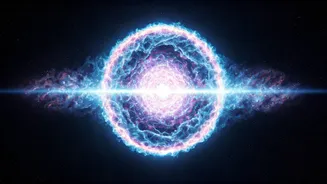
To investigate the magnetar hypothesis, scientists meticulously analyzed both the optical and gamma-ray emissions from SN 2017egm, comparing these observations with theoretical models. These models simulated the outward flow of light and particles originating from a freshly formed magnetar. A key aspect of the models focused on how particles, particularly a cloud of electrons and positrons (matter and antimatter counterparts), would interact with the expanding shell of stellar debris ejected by the dying star. It is believed that this rapidly spinning magnetar expels these particles, forming what is termed a "magnetar wind nebula." This nebula is thought to enhance both the production and absorption of gamma-rays, possibly through the annihilation of matter and antimatter particles, releasing energy in the form of gamma-rays. These gamma-rays then interact with the supernova's outer debris, converting into lower-energy optical light, thus explaining the super-bright visible light observed.
The Gamma-Ray Leak
The process by which gamma-rays become observable from a supernova involves a temporal element. Approximately three months following the initial stellar core collapse, the expanding debris cloud cools down, allowing the high-energy gamma-rays to begin escaping. The magnetar model effectively accounts for the observed luminosity of SN 2017egm and the timing of its gamma-ray emissions during these initial months. However, scientists acknowledge that the model requires refinement to accurately describe the behavior of the visible light at later stages, when it begins to fade in a rather irregular fashion. This suggests that while the magnetar is likely the primary engine, other factors might influence the supernova's light curve over extended periods, possibly related to the complex interaction of the ejected material.
Future Observational Power
Looking ahead, astronomers are assessing the capabilities of new ground-based observatories, such as the Cherenkov Telescope Array Observatory (CTAO), to detect similar energetic events. Initial assessments suggest that the CTAO, with approximately 50 hours of observation time, could identify comparable cosmic explosions from distances up to around 500 million light-years. This enhanced observational power will be instrumental in finally deciphering the complexities of these exceptionally powerful supernovas. By studying the gamma-ray emissions from such events, scientists gain a novel and powerful method to probe their internal workings, furthering our understanding of stellar evolution and the extreme physics governing the universe.