






Beyond Human Faces
Facial recognition, once a domain solely for identifying humans, has undergone significant evolution, expanding its capabilities to encompass a wide array
of applications, including wildlife monitoring. The core principle involves analyzing unique facial features, creating a 'faceprint' for identification. This innovative approach offers substantial advantages over traditional methods like tagging, which can be invasive and labor-intensive. With advancements in machine learning, particularly deep learning algorithms, computers can now accurately distinguish individual bears, even with variations in lighting, pose, and fur condition. This precision opens exciting avenues for wildlife research and conservation, offering a non-invasive tool to study bear populations.
The Tech's Mechanics
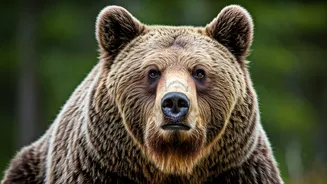
The process of adapting facial recognition for bears begins with collecting a comprehensive dataset of images. Researchers capture high-resolution photos of bears, focusing on key facial characteristics such as eye shape, muzzle contours, and fur patterns. These images are then fed into a machine-learning model, typically a convolutional neural network (CNN), trained to recognize and differentiate between individual bears. The CNN analyzes these visual data, extracting unique features and creating a facial signature for each bear. This signature allows the system to identify the bear in subsequent images or videos. Sophisticated algorithms are developed to address challenges like varying angles, lighting conditions, and partial face visibility, ensuring accurate and reliable identification.
Benefits for Conservation
The application of facial recognition technology in bear studies provides a suite of benefits for wildlife conservation. The ability to individually identify bears facilitates a deeper understanding of population dynamics. Researchers can monitor bear numbers, track movement patterns, and assess the impact of environmental changes on bear populations. The non-invasive nature of this technology minimizes stress on the animals, allowing for ethical data collection without physical intervention. Information gathered, such as reproductive success, survival rates, and social interactions, is vital for developing effective conservation strategies. Moreover, the technology can assist in detecting and deterring poaching by identifying specific bears at risk, safeguarding vulnerable populations.
Monitoring Bear Behavior
Beyond population assessment, facial recognition enables insights into bear behavior and social dynamics. By analyzing videos and images, researchers can observe interactions among bears, identifying dominant individuals, family relationships, and social structures. This data provides valuable context for understanding bear behavior in diverse environments. For instance, the technology can be used to study how bears respond to climate changes or how human activities influence their foraging patterns. This information helps conservationists and policymakers make informed decisions, developing strategies that safeguard both bears and their habitats. Furthermore, this also helps in understanding how human presence impacts the bears and their movement.
Data Collection and Ethics
The ethical considerations surrounding data collection and usage are crucial in deploying facial recognition for wildlife research. The focus needs to be on minimizing harm to the bears. The images and videos must be used responsibly, with strong data privacy and security measures in place. This includes safeguarding the data from unauthorized access, ensuring transparent data storage and usage, and securing consent from relevant stakeholders. Researchers must be transparent about the data collection methods and their purposes. Additionally, any facial recognition project requires thorough planning and validation to ensure the accuracy and reliability of the identification process. This prevents potential misidentification, which could lead to flawed conclusions or incorrect management decisions. Careful attention to ethical protocols upholds public trust and supports the long-term sustainability of wildlife conservation efforts.
Future Applications
The ongoing advances in artificial intelligence and machine learning suggest exciting possibilities for the future applications of bear facial recognition technology. The technology could integrate with other data sources, such as GPS collars and environmental sensors, creating more comprehensive and real-time monitoring systems. For instance, these systems could provide early warnings of habitat degradation or inform responses to human-wildlife conflicts. Furthermore, AI-powered analysis of bear facial expressions could shed light on their emotional states and behaviors, contributing to deeper insights into their cognitive abilities. The potential of the tech stretches beyond bear research; it can be used for other wildlife species. The continual developments in the field will help us gain a better understanding of wildlife, and develop conservation strategies accordingly.