







An Explorer's Discovery
The story of the bougainvillea, often admired for its papery, colourful displays, is intricately woven with the spirit of 18th-century global exploration.
This resilient plant, native to the lush terrains of South America—specifically regions like Brazil, Peru, and Argentina—was first formally identified by French botanist Philibert Commerçon. His encounter with this thorny vine occurred during a momentous global expedition captained by the famed explorer Louis Antoine de Bougainville. While Commerçon was the scientific mind documenting the flora, the plant's legacy was destined to be immortalized in the name of its expedition leader, underscoring the close symbiosis between scientific pursuit and the daring ventures of discovery during that era.
A Name of Renown
The nomenclature of this eye-catching climber, known affectionately as the bougainvillea, presents an interesting historical footnote. Contrary to what one might assume, the plant was not christened in honour of the botanist, Philibert Commerçon, who first scientifically recorded its existence. Instead, its name pays tribute to Louis Antoine de Bougainville, the leader of the grand expedition during which Commerçon made his groundbreaking discovery. This naming convention vividly illustrates a period where the prestige and recognition of the explorer often took precedence, highlighting the interconnectedness of scientific endeavour and the ambitious voyages that defined the age.
Global Voyage & Trade
Following its initial discovery in South America, the bougainvillea embarked on a remarkable global journey, largely facilitated by the extensive colonial trade routes established in the 19th century. Introduced first to European botanical gardens, it soon began its wider dissemination. Through a network of botanical exchanges and commercial maritime trade, this hardy plant found its way to diverse corners of the world, including the Indian subcontinent. Its ability to adapt and thrive meant it was readily adopted into gardens and landscapes across the vast reach of colonial empires, becoming a familiar sight far from its native origins.
The Illusion of Flowers
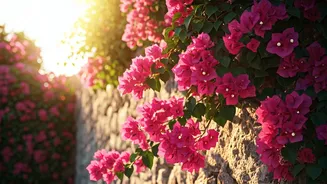
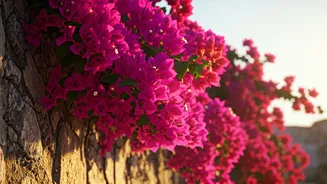
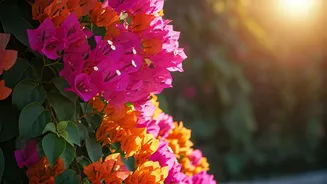
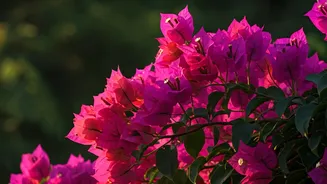
One of the most intriguing aspects of the bougainvillea is the nature of its vibrant 'flowers.' What captivates the eye and draws admirers is, in fact, not the bloom itself, but a modified leaf structure known as bracts. These bracts are brilliantly coloured and serve the crucial function of attracting pollinators. The plant's true flowers are considerably smaller and often inconspicuous, typically white or pale in colour, nestled discreetly within the centre of these showy bracts. This botanical peculiarity adds an element of surprise to the plant's already striking appearance.
A Garden Favourite
The bougainvillea's ascent to becoming a cherished garden staple across tropical and subtropical regions, particularly in India, is a testament to its exceptional resilience and aesthetic appeal. Its remarkable drought tolerance allows it to flourish even in arid conditions where other plants might struggle. Coupled with its spectrum of dazzling colours—ranging from vivid pinks and reds to purples and oranges—and its vigorous climbing or bushy habit, it has proven to be an adaptable and low-maintenance choice. These qualities have cemented its status as a beloved ornamental plant, adding a burst of colour to landscapes worldwide.