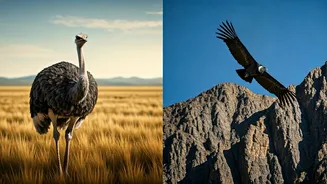







The Majestic Ostrich
Dominating the avian world in sheer size, the Ostrich reigns supreme as the largest and heaviest bird globally. These flightless wonders can soar to an impressive
height of 2.7 meters and tip the scales at over 150 kg. You'll find them thriving in the expansive savannas and arid deserts across Sub-Saharan Africa. Despite their inability to fly, Ostriches are remarkably swift runners, capable of outpacing many land mammals with speeds reaching up to 70 km/h, a crucial adaptation for survival in their open habitats.
Cassowary's Rainforest Realm
Residing in the lush tropical rainforests of New Guinea and northern Australia is the Southern Cassowary, a bird that is as heavy as it is visually striking. Standing up to 1.8 meters tall and weighing more than 70 kg, this flightless avian is distinguished by its vibrant blue neck and a unique, helmet-like casque on its head. Its preference for dense, secluded forest environments means sightings are quite rare, adding to its mystique and making encounters a special occasion for ornithologists and fortunate travellers alike.
Australia's Tall Emu
Following closely behind the Ostrich in stature, the Emu is Australia's second-tallest flightless bird, reaching nearly 2 meters in height. These birds are characterized by their long, powerful legs, which enable them to cover vast distances in search of sustenance and water. Emus are adaptable creatures, comfortably inhabiting a diverse range of Australian environments, including grasslands, open woodlands, and savannah landscapes, demonstrating their resilience and broad ecological niche.
Antarctica's Emperor
Venturing to the icy expanses of Antarctica, we encounter the Emperor Penguin, the largest and most substantial penguin species on the planet. These impressive birds can stand up to 1.2 meters tall and weigh as much as 45 kg. Their robust build is perfectly suited to the extreme cold of their polar habitat, where they are a truly iconic sight amidst the frozen landscapes, showcasing nature's ability to adapt life to the harshest conditions.
South America's Greater Rhea
In the expansive grasslands of South America, particularly in countries like Argentina and Brazil, the Greater Rhea makes its home. This flightless bird, which can grow up to 1.7 meters tall, shares some resemblance to a smaller Ostrich. Rheas are exceptionally agile runners, a vital trait for evading predators and navigating their open grassland territories, relying on speed as their primary defense mechanism.
Oceanic Wandering Albatross
The undisputed champion of aerial reach is the Wandering Albatross, boasting the largest wingspan of any bird, an astonishing 3.5 meters. These magnificent seabirds gracefully patrol the vast Southern Ocean. Their impressive wings are designed for effortless gliding over immense distances, allowing them to traverse oceans with minimal effort, a testament to their mastery of the air and oceanic currents.
Pelican's European & Asian Presence
Spanning wetlands across both Europe and Asia, the Dalmatian Pelican stands as one of the world's heaviest flying birds. This species can reach weights of up to 15 kg and possesses a wingspan nearing 3 meters. Its distinctive appearance, marked by curly nape feathers and a sizable bill, makes it easily identifiable, a prominent figure in the avian communities of these vast continental wetlands.
Andean Condor's Soaring Height
Symbolic of the majestic Andes Mountains in South America, the Andean Condor is among the most significant flying birds in terms of size. This impressive avian predator boasts a remarkable wingspan of 3.3 meters and is a prominent sight in the skies of countries like Peru, Chile, and Argentina, embodying the grandeur of its mountainous domain.
Africa's Heavy Kori Bustard
Hailing from the open grasslands of Africa, the Kori Bustard is often cited as the heaviest flying bird on Earth. The males of this species can reach weights of up to 18 kg. These birds are ground-dwellers, spending their time foraging for insects and small prey across the expansive savannas, demonstrating a different approach to life as a large flying bird.
Sarus Crane's Asian Wetlands
Recognized as the world's tallest flying bird, the Sarus Crane reaches an impressive height of up to 1.8 meters. Commonly found in the wetlands of South and Southeast Asia, it holds particular cultural significance in India, where it is often observed in monogamous pairs. Its stately presence and graceful demeanor make it a beloved and iconic bird in its native regions.