


The Lunar Rainbow Phenomenon
Yosemite National Park, renowned for its majestic granite cliffs and thundering waterfalls, harbors a secret spectacle that unfolds only under the cloak
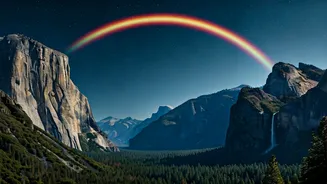
of night: the moonbow. This captivating phenomenon, a nocturnal counterpart to the familiar daytime rainbow, is a rare display where moonlight interacts with water droplets to create a luminous arc. While many may be familiar with the grandeur of Yosemite's daytime vistas, its allure extends into the darkness, offering a chance to witness one of nature's most ethereal illusions. These lunar rainbows are not a common sight globally; Yosemite is privileged to be one of the select locations on Earth where conditions are consistently favorable for their formation, drawing a dedicated band of watchers eager to catch a glimpse of this celestial artistry. The park's abundant waterfalls, especially Yosemite Falls, play a crucial role, providing the necessary mist for the moon's light to refract and create these shimmering arches.
Optimal Viewing Conditions
Witnessing a moonbow requires a specific alignment of natural elements, making them a sought-after and special occurrence. The primary requisites are a bright moon, ideally a full moon, and a significant amount of water spray. Yosemite's peak moonbow season typically spans from spring to mid-summer, coinciding with periods of increased water flow from its waterfalls due to snowmelt. However, precise viewing opportunities are intrinsically linked to the lunar cycle. For instance, in 2026, a prime viewing window was predicted for May 28 through June 3, underscoring the need to consult lunar calendars and local predictions. Beyond the moon and water, clear skies are essential. Overcast conditions can obscure the moonlight, preventing the bow's formation. Furthermore, the sun must be well below the horizon, indicating a truly dark sky, and the moon's position relative to the observer and the waterfall must be correct. These factors, first scientifically modeled by physicists and astronomy teams, combine with the intuitive understanding of naturalists like John Muir, who long ago recognized the interplay of moonlight and waterfalls.
The Science and Observation
The creation of a moonbow, much like its daytime counterpart, is a matter of light refraction and reflection. However, the perception of moonbows differs significantly from that of rainbows. To the naked eye, moonbows often appear as pale, silvery or grayish arcs. This is due to the way our eyes' photoreceptors, specifically the rods, function in low-light conditions. Rods are more sensitive to light intensity than color, meaning they struggle to differentiate hues in the dim glow of moonlight. Consequently, the vibrant colors seen in daytime rainbows are typically lost to our direct vision at night. Modern digital cameras, equipped with long exposure capabilities, can capture far more light, revealing the full spectrum of colors present in a moonbow, often mirroring the vividness of a daytime rainbow. This distinction highlights the technological advantage in documenting these elusive spectacles, while also underscoring the unique, almost spectral, visual experience for those fortunate enough to see them with their own eyes.
Navigating the Moonbow Hunt
The pursuit of moonbows in Yosemite is an adventure that combines a passion for nature with a bit of strategic planning. Many enthusiasts, often referred to as 'moonbow hunters,' rely on the expertise of individuals who have dedicated themselves to predicting these events. Brian Hawkins, for example, has been a prominent figure in this community, continuing the work of predicting optimal viewing times and locations after physics professor Donald Olson retired from such efforts. Websites and online communities dedicated to Yosemite often share these predictions, fostering a collaborative spirit among seekers. The experience of moonbow hunting can range from casual strolls to more strenuous expeditions. While viewing at the base of Lower Yosemite Fall is relatively accessible, some dedicated observers venture to more challenging locations, like Upper Yosemite Fall, even rappelling to precarious ledges for a unique vantage point. This dedication speaks to the profound impact of witnessing a moonbow, a moment that transcends mere observation and becomes a deeply personal and awe-inspiring encounter with the natural world.
Yosemite's Best Viewing Spots
Yosemite National Park offers several prime locations for experiencing the magic of moonbows, with its magnificent waterfalls serving as the natural stage. Yosemite Falls, one of North America's tallest, is frequently cited as an exceptional spot due to the sheer volume of mist it generates, which is crucial for moonbow formation. The base of Lower Yosemite Fall provides a readily accessible viewing point, allowing many visitors to witness the spectacle without extensive hiking. For those seeking a more dramatic or unique perspective, venturing to higher elevations like the Upper Yosemite Fall trail has been undertaken by dedicated photographers and adventurers. These more challenging treks, though physically demanding and requiring nighttime navigation, offer the potential for unparalleled views and photographic opportunities. Other areas with significant waterfalls, such as Bridalveil Fall, might also offer moonbow viewing possibilities, depending on the specific lunar and hydrological conditions. The key is to be near a substantial water source with ample spray when the moon is bright and the sky is clear.