



A World of Wonder
Titan, Saturn's most substantial moon, presents a fascinating enigma with its dense atmosphere, flowing rivers and lakes of liquid methane, and a suspected
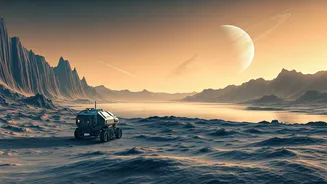
hidden ocean. These extraordinary features have spurred proposals for it to become humanity's next significant exploration goal, following our endeavors on the Moon and Mars. The allure of exploring such an alien, yet strangely familiar, world is undeniable, though the path forward is fraught with considerable obstacles. Its atmosphere, predominantly nitrogen like Earth's, is far denser and frigid, with surface temperatures plummeting to approximately -179 degrees Celsius (-290 degrees Fahrenheit). What truly sets Titan apart is the presence of liquid methane and ethane on its surface, forming an intricate network of lakes, rivers, and seas, driving a dynamic weather system complete with methane rain and clouds, making it a truly unique celestial body.
Hidden Ocean's Promise
Beneath its icy exterior, Titan is thought to conceal an extensive reservoir of liquid water, potentially mixed with ammonia. This sub-surface ocean is considered a prime location for the existence of life, rendering Titan an exceptionally compelling target for astrobiological investigations. The Cassini-Huygens mission, which diligently orbited Saturn from 2004 to 2017, furnished an invaluable wealth of data concerning Titan. This included remarkable imagery and crucial atmospheric readings captured by the Huygens probe during its historic descent and landing on the moon's surface, offering unprecedented insights into this distant world.
Humanity's Hurdles
Undertaking human expeditions to Titan, however, introduces a multitude of formidable challenges. The extreme frigidity of the environment, the sheer density of its atmosphere, and the considerable duration of the journey from Earth all represent significant impediments. Developing the necessary technologies to ensure long-term human survival and effective exploration within such an alien setting would necessitate substantial technological leaps and innovations. Despite these daunting obstacles, the scientific community maintains a robust enthusiasm for Titan's potential. Upcoming missions, such as the revolutionary Dragonfly rotorcraft, are meticulously planned to conduct more in-depth explorations of both its surface and subsurface regions, further fueling our understanding.
Navigating Titan's Terrain
For any future human explorers on Titan, navigating the environment presents unique opportunities due to its distinct atmospheric conditions. Unlike the Moon or Mars, Titan's atmospheric pressure is higher than Earth's, meaning a full pressure suit isn't strictly necessary, though protection against the extreme cold is paramount. The presence of a substantial atmosphere coupled with lower gravity than Earth's moon opens up exciting possibilities for personal transport. Imagine strapping on wings and gliding through the air or utilizing a jetpack for efficient movement across the landscape. These atmospheric advantages are precisely what missions like Dragonfly are designed to leverage, offering a glimpse into how humans might one day traverse this alien world with relative ease, provided they can overcome the necessity of generating their own oxygen and managing the accumulation of surface material.
The Path Forward
The question of whether Titan should indeed become humanity's subsequent major destination after the Moon and Mars is a multifaceted one, intrinsically linked to scientific curiosity, the feasibility of current and future technologies, and our overarching long-term aspirations for space exploration. Organizations are actively convening to meticulously plan such endeavors. For instance, the Humans to Titan Summit 2026 aims to explore the concept of Titan as the next frontier, detailing how such a mission could be achieved and identifying the immediate prerequisites. This collaborative effort seeks to invigorate the scientific community, fostering a deeper consideration of the possibilities and planting the seeds for what could be a real, tangible future for human presence on this remarkable moon.