







Freshness is Key
The most significant leap in your home coffee experience hinges on the beans you choose and how they're kept. Coffee's peak flavor window is remarkably
short, typically within three to four weeks post-roasting. Beyond this period, the volatile CO2 gas responsible for the satisfying 'bloom' begins to dissipate, taking a substantial portion of the nuanced flavors with it. Supermarket pre-ground coffee, often sitting on shelves for weeks or even months, has already lost much of its aromatic potential due to its increased surface area, which accelerates oxidation and staleness. Opting for whole beans and grinding them just before you brew is a game-changer. Seek out roasters who clearly mark the roast date on their packaging, rather than just an expiry date. Many specialty roasters now offer direct online sales and roast-to-order services, ensuring you receive beans at their freshest. A smaller bag of freshly roasted whole beans, consumed within its prime, will invariably yield a superior cup compared to a larger bag of pre-ground coffee that has been exposed to air.
Grind Your Own Beans
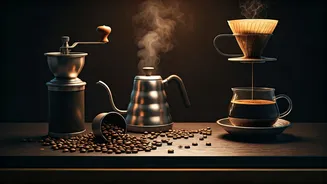
Once you've secured high-quality whole beans, the next crucial step is to grind them yourself. Investing in a basic manual grinder, which can be found online for a reasonable price, is highly recommended. The size of your coffee grind is not a trivial detail; it's a fundamental determinant of how efficiently water can extract flavor from the coffee particles. Using an inappropriate grind size will inevitably lead to either over-extraction, resulting in a bitter and harsh taste, or under-extraction, producing a sour and weak beverage, regardless of the bean's quality. As a general guideline, coarser grinds are best suited for brewing methods where coffee and water have prolonged contact, such as a French press or cold brew. Medium grinds are ideal for pour-over and drip coffee makers, while finer grinds are necessary for devices like a moka pot. If your coffee consistently tastes bitter, try a coarser grind; conversely, if it's sour or watery, opt for a finer grind. Adjusting your grind size is your most potent tool for fine-tuning flavor, and it doesn't cost a penny.
Water Temperature Matters
Using water at a full boil, which registers at 100°C, is often too hot for optimal coffee brewing. This extreme heat can scorch the coffee grounds, leading to the extraction of bitter compounds that detract from the overall taste. The sweet spot for brewing coffee typically lies between 90°C and 96°C. Achieving this temperature is simpler than you might think: simply bring your water to a boil and then allow it to rest for about 30 to 45 seconds before pouring. This brief waiting period is sufficient to bring the temperature down to the ideal range without the need for a thermometer. This straightforward adjustment significantly enhances the coffee's flavor profile, allowing more delicate, sweet, and aromatic notes to emerge rather than being overpowered by bitterness. While this principle is well-known for brewing delicate teas like green or white, coffee also benefits immensely from this careful temperature control, consistently leading to a more pleasant and well-rounded cup.
Choose Your Brew Method
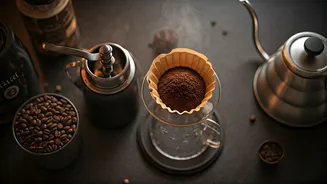
The conversation about needing an espresso machine becomes moot when you explore simpler, yet highly effective, brewing methods. Two exemplary techniques that consistently produce exceptional coffee at home require no electricity and minimal investment: the pour-over and the French press. A pour-over setup, which involves a filter cone placed over a mug or carafe, yields a remarkably clean, bright, and aromatic cup with outstanding clarity. The process is intuitive: add your ground coffee to the filter, briefly saturate it with hot water to allow the coffee to 'bloom' (release trapped gases), wait for about 30 seconds, and then slowly pour the remaining water in a concentric spiral motion. This entire procedure, taking roughly three minutes, can rival the quality of coffee served in many mid-tier cafes. The French press, even more straightforward, involves adding coarsely ground coffee to its glass carafe, pouring in the correctly heated water, steeping for four minutes, gently pressing the plunger, and then serving. The French press produces a richer, fuller-bodied cup because its metal filter allows coffee oils, which paper filters trap, to pass through into the brew. For those in India accustomed to the robust character of traditional filter coffee or decoction, the French press will likely feel very familiar and satisfying.
Measure for Consistency
Achieving consistent, cafe-quality results at home doesn't require guesswork; it involves precise measurement, a practice fundamental to professional baristas. This disciplined approach is the most rapid pathway to replicating excellent results. The widely accepted coffee-to-water ratio for most brewing methods falls between 1:15 and 1:17, meaning for every gram of coffee, you use 15 to 17 milliliters of water. For instance, a standard 250 ml cup would typically require approximately 15 to 17 grams of coffee. A basic kitchen scale, available for a modest price, eliminates all variables. Using too much coffee can lead to an overpowering, sometimes astringent brew, while too little coffee results in a weak, watery beverage. Committing to weighing your coffee and water for a few weeks will train your palate and refine your instincts, eliminating the daily uncertainty about why your cup tastes different. The remarkable consistency found in cafes is almost entirely attributed to this meticulous attention to detail and repetition. By adopting similar practices at home, even in a simplified manner, you significantly bridge the gap between your kitchen and your favorite coffee shop.
Smart Coffee Storage
Protecting your coffee from its primary adversaries – air, moisture, heat, and light – is essential for preserving its flavor. While the original packaging, whether a tin or a paper bag, can be adequate for short-term storage if properly sealed, it's best to transfer opened coffee into a small, airtight container. This container should be kept at room temperature, away from direct heat sources like your stove and shielded from sunlight. It's generally advisable to avoid refrigerating or freezing coffee unless you're storing a very large quantity for an extended period, as the temperature fluctuations can cause condensation, which is detrimental to the beans. A well-sealed ceramic or stainless steel canister is an affordable solution for maintaining freshness for several weeks. Buying smaller quantities of coffee more frequently, such as a 250g bag intended for consumption within three weeks, will ensure a far superior taste experience compared to a 500g bag that lingers for two months.