





The Cosmic Computing Vision
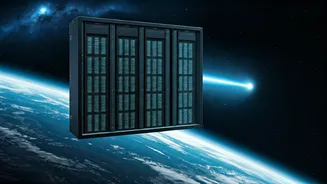
The idea of relocating data centers from our planet to the vastness of space is no longer pure science fiction, thanks to forward-thinking leaders like
Cisco's CEO, Chuck Robbins. He has publicly confirmed that his company is actively engaged in discussions and preliminary explorations concerning the feasibility of establishing data centers beyond Earth's atmosphere. This bold vision is driven by the desire to transcend several inherent constraints that limit terrestrial data center operations. Factors such as the immense power requirements, the constant challenge of heat dissipation, and the finite availability of suitable land parcels on Earth are significant bottlenecks. In contrast, space offers an environment with virtually limitless solar energy, potentially negating power concerns. Furthermore, the absence of human populations in orbit would eliminate the local community objections and environmental impact concerns that often plague large, energy-intensive facilities on our planet, although new and different objections might arise in the space domain.
Challenging Terrestrial Boundaries
The push towards space-based data centers is gaining traction, influenced by prominent figures who believe that locating these critical infrastructures away from populated areas is a more sensible approach. While some, like Sam Altman, express skepticism about the practicality of a "pipe dream" scenario for space-bound data centers, suggesting they shouldn't be in our backyards, the debate is far from settled. Cisco's CEO, when posed with the choice between Altman's reservations and Elon Musk's enthusiastic support, indicated a leaning towards the latter's perspective, stating, "I wouldn’t bet against Elon." This sentiment reflects a broader industry trend where hyperscale operations, vital for today's digital world, are increasingly met with public resistance. Concerns over noise pollution, substantial energy consumption, and the environmental footprint of these facilities are becoming major obstacles. Yet, the insatiable demand for data processing and storage continues to drive the need for ongoing expansion, creating a paradoxical situation where growth is essential but increasingly difficult to achieve on Earth.
Navigating Technical Frontiers
Despite the compelling advantages, the journey to establishing data centers in space is fraught with significant technical complexities that Cisco is actively working to resolve. The extreme and fluctuating temperatures encountered in orbit present a formidable challenge for sensitive electronic equipment, requiring innovative cooling and thermal regulation solutions. Moreover, the unique atmospheric conditions and the vacuum of space necessitate specialized hardware and robust design principles. The logistics of launching and maintaining such infrastructure also pose substantial hurdles, from the cost of rocket launches to the intricate processes of assembly and repair in a zero-gravity environment. Beyond the physical engineering, there are also evolving considerations around data sovereignty. As governments and organizations increasingly prioritize where their data resides, the implications of hosting it in space, potentially beyond national jurisdictions, remain largely undefined and will likely necessitate a fundamental rethinking of infrastructure architecture, shifting away from global systems towards more localized, yet potentially orbital, deployments.
The Road Ahead
The exploration of space-based data centers is currently in its nascent stages, with Cisco and its partners diligently working through a multitude of critical considerations. The immediate focus, as articulated by CEO Chuck Robbins, is on thoroughly assessing and mitigating the environmental challenges inherent to space operations. This includes a deep dive into atmospheric effects, temperature regulation strategies, and the overall design requirements to ensure the reliability and longevity of computing infrastructure in orbit. The company acknowledges that the full scope of necessary adaptations and technological advancements is still being uncovered. When directly asked about the ultimate viability of placing data centers in space, Robbins expressed a definitive affirmative, underscoring his conviction that this is not only a possible but a necessary step for the future of computing. The commitment to understanding all facets of this ambitious undertaking highlights a proactive approach to shaping the next generation of digital infrastructure.