





Next-Gen Space Medicine
Astronauts on the International Space Station (ISS) are at the forefront of a medical revolution, testing cutting-edge augmented reality (AR) and artificial
intelligence (AI) systems designed to bolster in-orbit healthcare and drastically decrease their dependence on Earth-based mission control. This pioneering effort marks a significant milestone in enabling astronauts to manage their health autonomously as they embark on journeys farther from our home planet. The latest trials involve astronauts using AR to meticulously guide themselves through intricate ultrasound scans of their internal organs. Following the scans, an advanced AI model takes over, swiftly and accurately identifying these organs. This integration represents the initial phase of incorporating AI into astronaut support systems, aiming to provide rapid, on-the-spot medical assistance crucial for extended space voyages where communication delays are unavoidable. The Expedition 74 crew, for instance, is actively involved in these preparations, underscoring the growing importance of these technologies for future space exploration initiatives.
AR-Guided Ultrasounds
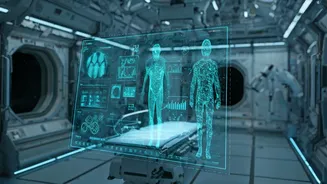
During recent simulations, astronauts practiced performing ultrasound examinations on each other, mimicking a scenario where ground support is unavailable. The augmented reality system played a pivotal role, offering real-time visual guidance. It overlaid step-by-step instructions directly into the astronauts' field of vision, adapting and updating the directions as they proceeded with the scan. This ensured the procedure was conducted with precision, even for those who may not be medical imaging specialists. The AI component then analyzed the ultrasound images captured by the astronauts. This artificial intelligence demonstrated remarkable accuracy by correctly identifying various internal organs within the scans. While this might seem like a foundational application of AR and AI, it serves as a crucial proof of concept for the sophisticated medical support systems envisioned for future long-duration missions, especially as crews venture beyond lunar orbits towards Mars and beyond.
AI's Crucial Role
The successful integration of AI in identifying organs during these simulated medical procedures highlights its potential to serve as an invaluable asset for space crews. As astronauts venture further into the cosmos, the communication lag with Earth can extend to several minutes, making immediate medical interventions challenging. AI-powered diagnostic tools can bridge this gap, offering immediate expert-level insights. This technology can empower astronauts with enhanced diagnostic capabilities, even in areas where their individual expertise might be limited. Furthermore, it acts as a vital knowledge backup, providing crucial assistance if an astronaut becomes incapacitated, mitigating the risks associated with waiting for a delayed response from ground control. The successful mapping of the Perseverance rover's route on Mars using AI further demonstrates the expanding utility of this technology in space exploration, showcasing its versatility beyond medical applications and reinforcing its growing importance in enabling future human endeavors in space.