




Ancient Views on Planets
In the ancient world, the concept of a planet was markedly different from what we understand today. Early astronomers, lacking advanced tools, often grouped
planets with other celestial wanderers. They observed these objects moving across the backdrop of fixed stars, a movement that set them apart. The primary focus was on their movement across the sky, rather than their physical composition or characteristics. These observations were intertwined with mythology and religious beliefs, often associating planets with gods and goddesses. Consequently, what constituted a 'planet' was more about its visible behavior and cultural significance, rather than scientific criteria. Early civilizations like the Greeks and Babylonians were able to chart the movements of the major planets like Mercury, Venus, Mars, Jupiter, and Saturn, contributing significantly to the initial study of these celestial wanderers, laying the foundation for future astronomical studies.
The Rise of Definitions
As scientific advancements accelerated, so did our understanding of planets, compelling a more precise classification. The development of telescopes unveiled the physical properties of planets, differentiating them from stars and other celestial bodies. The Copernican Revolution, which placed the Sun at the center of our solar system, was a pivotal moment. The focus shifted from the Earth-centric view to a heliocentric model, fundamentally altering the conceptualization of planets. The discovery of Uranus in 1781 further complicated the definition. New observations and discoveries constantly stretched the boundaries of what could be considered a planet, leading to debates among astronomers. These debates highlighted the need for more consistent and comprehensive criteria for planet classification, thus pushing the scientific community toward more formal definitions based on physical properties and orbital characteristics.
Gravity's Central Role
Gravity has emerged as the defining factor in understanding the formation and behavior of planets. This force governs the accretion process, where particles coalesce under gravitational pull to form larger bodies, eventually leading to planets. A celestial body's shape is determined by its gravity; sufficient mass allows an object to achieve a nearly spherical shape, which is a key criterion for planetary status. Furthermore, gravity dictates the orbital paths of planets around stars, and this gravitational dominance is critical for clearing the orbital neighborhood of other debris. The size and composition of a celestial body are profoundly impacted by its gravity, which influences their internal structure. The absence of sufficient gravity hinders a body from achieving planetary status. It's the balance of gravity and other forces that determines whether a celestial body can be classified as a planet, a dwarf planet, or another class of object.
Pluto's Controversial Demise
Pluto's demotion from a planet to a dwarf planet in 2006 marked a significant turning point in the scientific community. The discovery of other objects, like Eris, in the Kuiper Belt, which were similar in size or larger than Pluto, challenged its planetary status. The International Astronomical Union (IAU) established a formal definition for planets, requiring that a planet must orbit the Sun, be massive enough for its own gravity to make it round, and have cleared its orbit of other objects. Pluto met the first two criteria, but had not cleared its orbital neighborhood, sharing its space with numerous other objects in the Kuiper Belt. The decision was not without controversy. Some scientists and the public initially resisted the change, emphasizing Pluto's historical classification and its importance as a familiar planetary body. Yet, the new definition provided a standardized way to differentiate between planets and other celestial objects, making the classification more consistent across the scientific community.
Continuing Planetary Discoveries
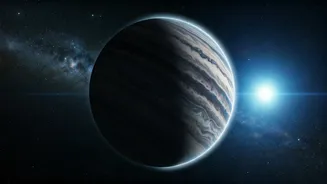
Modern astronomy is continually expanding our understanding of what constitutes a planet through advancements in telescope technology and space exploration. The discovery of exoplanets, planets orbiting stars other than our Sun, has created a wealth of data, forcing scientists to refine their criteria. Characterizing exoplanets involves analyzing their size, composition, orbital parameters, and potential habitability. The James Webb Space Telescope and other sophisticated tools provide detailed insights into their atmospheric composition, temperature, and the presence of water or other indicators of life. The ongoing search for exoplanets has expanded the discussion to include the potential for habitable zones around other stars and the conditions that might support life elsewhere. These new discoveries challenge us to rethink and adapt the existing definitions to accommodate these newly discovered worlds, pushing the boundaries of our knowledge.