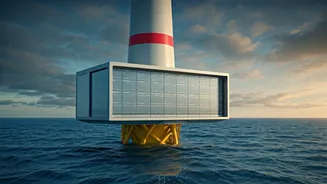








Offshore AI Powerhouses
A forward-thinking startup based in San Francisco, Aikido Technologies, is pioneering a revolutionary concept: embedding data centers within offshore wind
turbine structures. This ambitious project aims to provide a sustainable and readily available power source for the burgeoning field of artificial intelligence. The company is set to debut a compact, 100-kilowatt unit by the end of 2026 off Norway's coast in the North Sea, which will ingeniously combine a wind turbine with an AI server. This innovation is designed to alleviate the significant power and spatial challenges that large-scale AI operations, often referred to as hyperscalers, are currently grappling with. Furthermore, it offers a potential bypass for the common local opposition, known as 'not in my backyard' disputes, that frequently hinder land-based data center developments. The venture capital in this space is recognizing this as a critical growth opportunity.
Innovative Turbine Design
Aikido is leveraging a robust, semi-submersible design for its offshore wind turbines, a structure familiar to the oil and gas industry for deep-sea operations. These platforms feature three ballast-filled legs, strategically filled with fresh water to ensure stability and buoyancy. For anchoring, the turbines are secured to the seabed using chains and anchors, guaranteeing their position even amidst challenging wind and ocean conditions. The ingeniously designed structure allows for the integration of substantial data halls, potentially up to 3 to 4 megawatts, within the upper sections of each leg. This means a single wind turbine could effectively function as a 9 to 12-megawatt data center. The fresh water used for ballast also plays a crucial role in cooling the AI chips. As the water circulates through the cooling systems, it warms up and is then pumped back into the ballast tanks, where the cold waters of the North Sea cool it down. Additional air-conditioning units are also in place to manage the temperatures of components outside this primary water-cooling loop.
Cost-Competitive & Sustainable
The strategic integration of data centers with wind energy presents a compelling case for cost competitiveness. Aikido CEO Sam Kanner highlights that the abundance of wind power and the availability of natural cooling solutions significantly reduce operational expenses compared to conventional land-based data centers. This unique synergy positions the company to offer a more economical solution for AI computing where it is most needed. Kanner views the current demand for AI infrastructure as a prime opportunity for this technology to prove its viability and scalability over the next five years. By harnessing renewable energy and utilizing natural cooling, Aikido aims to provide a sustainable and cost-effective platform for the demanding computational needs of artificial intelligence, addressing both the power and space limitations that are becoming increasingly problematic for the industry.
Addressing Power Challenges
Despite the innovative approach, the deployment of wind-powered offshore data centers faces inherent challenges. Wind energy's natural variability requires robust energy storage solutions; thus, each unit will be equipped with batteries to store excess energy and ensure consistent power delivery during periods of low wind. In instances where low production extends beyond anticipated durations, the system is also designed to connect to the existing power grid, allowing it to draw energy from other sources. The marine environment itself presents considerable hurdles. Saltwater, in particular, is highly corrosive, which could lead to increased maintenance costs and complexity. Nevertheless, these pioneering experiments hold significant promise for overcoming the power and space limitations currently confronting land-based data centers. Notably, China has explored similar concepts, having launched a prototype wind-powered underwater data center in Shanghai. While ambitious, such projects appear more achievable than more speculative ventures, such as placing a million data centers in orbit.