

Mission Launch and Trajectory
On May 15th, a SpaceX Falcon 9 rocket successfully ascended from Space Launch Complex 40 at Cape Canaveral Space Force Station, initiating the CRS-34 cargo
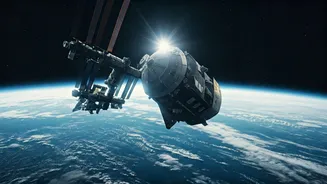
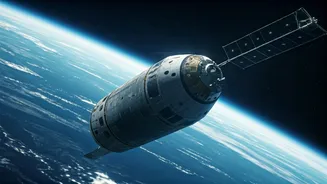
mission to the International Space Station. The launch, initially slated for May 12th, faced weather-related delays, followed by a scrub on May 13th due to last-minute technicalities concerning launch weather criteria. Approximately ten minutes post-liftoff, the Dragon spacecraft achieved separation from the Falcon 9's upper stage. This autonomous vehicle is on course to rendezvous and dock with the station's Harmony module, with the docking anticipated around 7 a.m. Eastern time on May 17th, marking a critical phase in its operational deployment. This mission underscores the reliability and incremental improvements in SpaceX's launch cadence and payload delivery capabilities.
Dragon Capsule's Sixth Flight
The Dragon spacecraft undertaking the CRS-34 mission is not a newcomer to orbital journeys; it is designated C209 and is making its sixth trip to the ISS. This marks a significant milestone, as it's the first cargo Dragon to achieve this level of flight history, paralleling the accomplishment of the Crew Dragon spacecraft Endeavour. SpaceX's senior mission manager, Lee Echerd, explained that much of the certification work for multiple flights was already completed during the development of the Crew Dragon program. For this specific cargo configuration, the certification process primarily involved a delta certification, focusing on hardware components that are unique to the cargo variant of the Dragon capsule. This efficiency in leveraging prior development efforts allows for more frequent and cost-effective resupply missions.
Payloads: Science and Exploration
The CRS-34 mission is transporting a substantial payload of 2,948 kilograms to the International Space Station, featuring an 816-kilogram external component. This significant external payload is known as Space Test Program-Houston 11, a collaborative effort between NASA and the U.S. Space Force. It encompasses a variety of experiments, including STORIE, an instrument designed to meticulously study charged particles present in Earth's orbit. Also on board is the CLARREO Pathfinder, an advanced Earth science instrument tasked with performing highly precise measurements of sunlight reflected off the Earth and the Moon. These measurements are crucial for refining and improving the accuracy of Earth science data. It's noteworthy that CLARREO Pathfinder faced potential cancellation in previous years, illustrating the dedication to bringing important scientific instruments to fruition.
Expanding Scientific Horizon
Beyond the specialized payloads, CRS-34 carries over 50 distinct science investigations, representing a broad spectrum of research funded by NASA, international collaborators, and the ISS National Laboratory. According to Liz Warren, deputy chief scientist for the ISS program at NASA, these investigations extend to supporting both NASA's ambitious exploration initiatives and various commercial ventures. Warren observed that as the ISS approaches its retirement around the close of the decade, there isn't a significant shift in the fundamental research areas, but rather a discernible trend towards a "finer resolution and focus" on the ongoing work. This suggests a deepening of understanding and more targeted experiments as the station's operational lifespan continues.
Upcoming ISS Missions
The CRS-34 mission is part of a robust schedule of Dragon resupply flights planned for 2026, being the second of four such missions. This follows the Crew-12 mission which launched earlier in February, with Crew-13 slated for mid-September and CRS-35 planned for the autumn. Bill Spetch, NASA's ISS operations and integration manager, detailed other anticipated arrivals to the station. These include the Soyuz MS-29 crewed mission in July, a Progress cargo spacecraft expected in early September, and a Cygnus cargo spacecraft scheduled for late fall or early winter. The manifest notably excludes Boeing's CST-100 Starliner, which had been projected for an uncrewed test flight this year, but its schedule remains uncertain due to ongoing investigations into issues encountered during a 2024 crewed test flight.
Orbital Launch Activity
The CRS-34 launch marked the first Falcon 9 mission from Cape Canaveral in a two-week interval, an unusually extended pause in SpaceX's launch cadence. This event represented SpaceX's 57th orbital launch of the year, comprising 56 Falcon 9 missions and one Falcon Heavy launch. At this pace, the company is projected to conduct 154 launches in the current year, a slight decrease from the 165 launches achieved in 2025. This consistent launch activity highlights SpaceX's pivotal role in maintaining the flow of resources and scientific equipment to low Earth orbit and beyond, supporting various space exploration and research objectives.