






Understanding Aurora Triggers
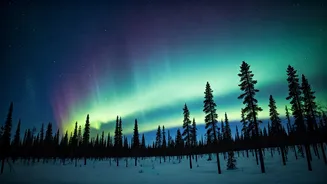
The captivating dance of the aurora borealis is a direct result of our Sun's energetic activity interacting with Earth's magnetic field. When the Sun ejects
charged particles, often in the form of solar winds or coronal mass ejections (CMEs), these particles travel across space. Upon reaching Earth, they are guided by our planet's magnetic field towards the polar regions. As these high-energy particles collide with gases in our atmosphere, primarily oxygen and nitrogen, they excite these atoms and molecules, causing them to emit light. The colors we observe – predominantly green and pink, but also red and blue – depend on the type of gas and the altitude of the collision. Therefore, understanding the Sun's behavior is key to predicting aurora displays. Events like solar flares and coronal holes are primary sources of these particle streams that can ignite our night skies. The intensity and duration of these solar events directly correlate with the strength and visibility of the auroras.
Geomagnetic Storms and Visibility
Geomagnetic storms are a crucial factor in determining how far south the northern lights can be seen. These storms occur when a significant amount of charged particles from the Sun, often from a CME, impacts Earth's magnetosphere, causing a disturbance. During a geomagnetic storm, Earth's magnetic field is significantly perturbed, which in turn can cause auroras to extend to lower latitudes than usual. For instance, a G4 (severe) geomagnetic storm might allow auroras to be visible in states as far south as Illinois and Oregon, whereas typically they are confined to higher latitudes. Forecasting these storms, often measured by the Kp index, is essential for aurora enthusiasts. A higher Kp index signifies a stronger geomagnetic storm and a greater likelihood of widespread aurora sightings. Even minor geomagnetic storms can enhance aurora visibility, especially in northern regions. The timing of these solar events, whether they are 'Earth-directed' or glancing blows, greatly influences their impact on our planet and the resulting aurora displays.
Anticipating Aurora Forecasts
Keeping track of aurora forecasts is an exciting endeavor that requires monitoring various space weather indicators. Forecasters analyze data on solar wind speed, density, and magnetic field orientation, as well as the frequency and intensity of solar flares and CMEs. This information is used to predict the likelihood and intensity of geomagnetic storms. Reports often highlight periods of 'elevated conditions' or 'unsettled geomagnetic activity,' which signal good news for aurora chasers. Conversely, periods of 'quiet skies' or 'waning solar winds' suggest lower chances of spectacular displays. It's common to see forecasts mention specific dates or weekends with promising aurora potential, often tied to the arrival of fast solar wind streams or incoming CMEs. Staying updated through dedicated aurora forecast channels allows individuals to plan their viewing and increase their chances of witnessing this natural phenomenon, whether it's a faint glow at high latitudes or a vibrant show dipping into mid-latitudes.