
Supernova's Ancient Light
The James Webb Space Telescope has achieved a remarkable feat by identifying the oldest supernova ever observed. This incredible discovery allows scientists
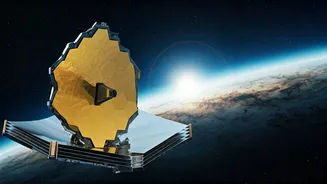
to travel back in time, witnessing the explosive death of a star from the early universe. This finding is not merely a milestone; it offers critical clues about the stellar processes and the composition of the universe in its infancy. Studying this ancient supernova provides valuable data for understanding how stars evolve and disperse elements throughout the cosmos, laying the foundation for future generations of stars and planets. The JWST's ability to peer deep into space and time, capturing light emitted billions of years ago, is revolutionizing the field of astrophysics, enabling scientists to observe events that shaped our universe.
Black Holes' Voracious Appetites
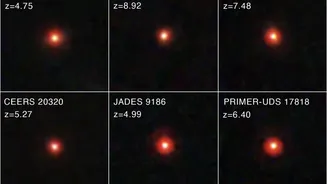
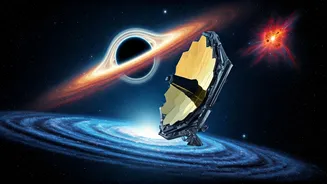
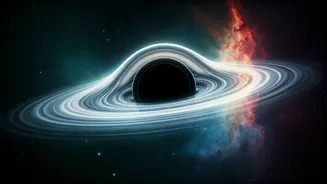
JWST's capabilities have allowed it to observe supermassive black holes in the early universe, revealing their active role in galactic evolution. One notable observation involves a rapidly feeding black hole in the infant universe, a discovery considered truly remarkable by researchers. These black holes are consuming matter at an astonishing rate, profoundly influencing their surrounding galaxies. The telescope's observations also uncovered a 'big red dot' associated with a ravenous supermassive black hole. The study of these black holes provides insight into how galaxies formed and evolved, the behavior of matter under extreme gravitational conditions, and the growth of these cosmic giants over cosmic time. These findings contribute to a deeper understanding of the universe's dynamic and energetic processes.
Early Universe Glimpses
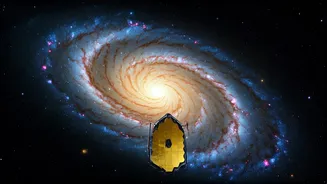
The James Webb Space Telescope offers a window into the formation and evolution of galaxies. It has observed a 'gassy baby galaxy' throwing a tantrum in the early universe, providing valuable data on the processes of galaxy formation. Additionally, the telescope has captured a 'one-of-a-kind' triple star system, resembling a cosmic embryo. These observations help scientists understand how galaxies come together, the star formation mechanisms, and the intricate structures that evolve over billions of years. By observing the universe in its infancy, JWST contributes to a comprehensive picture of cosmic development, highlighting key moments and processes that have shaped the cosmos into its current state. These findings continually inspire and reshape our understanding of the universe's evolution.
Observing Dying Stars
The James Webb Space Telescope's high-resolution instruments have identified a dust-cloaked 'red supergiant' star just before it went supernova. This gives astronomers a unique opportunity to study the lead-up to a supernova event and understand the physical changes that occur within a dying star. Scientists are also watching the shockwave from a supernova shoot through a dying star. These findings offer important clues on the end-of-life stages of massive stars, the nature of stellar explosions, and the spread of heavy elements into space. As the elements from these stellar deaths are scattered into the cosmos, they become the building blocks for new stars, planets, and even the ingredients for life. The telescope's ability to provide a detailed view of these events is revolutionizing the study of stellar evolution.