








Artemis II Launch Update
NASA's ambitious Artemis II mission, designed to return humans to the Moon, has experienced a postponement. Originally slated for a February launch, the mission's
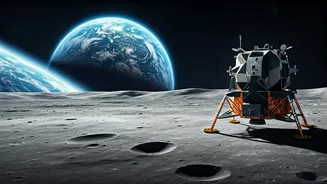
commencement has been pushed back to allow for thorough analysis following a crucial "wet dress rehearsal." This vital test, designed to simulate countdown procedures and assess spacecraft performance, revealed aspects requiring further evaluation to ensure the safety and success of the crewed journey. The next available launch window is now scheduled for March 6th. This mission marks a significant milestone, as it will be the first time humans venture beyond Earth's orbit since 1972. Furthermore, Artemis II is set to make history by including the first woman and the first person of color to travel into deep space, broadening the representation in space exploration's next chapter.
Mars Rover Autonomy Advances
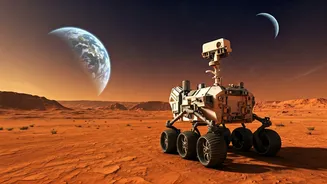
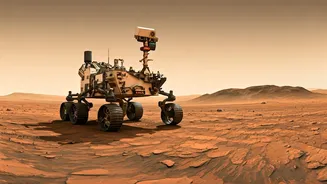
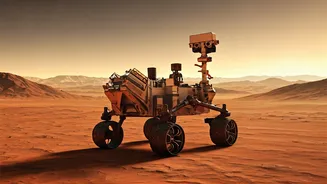
On the Martian surface, NASA's Perseverance rover has demonstrated a significant leap in robotic exploration capabilities with its first AI-guided drive. This innovative maneuver involved the rover autonomously analyzing detailed terrain data to plot a safe and efficient course across the Red Planet. This groundbreaking trial serves as a critical test for advanced autonomous systems, assessing their potential to dramatically enhance the operational efficiency and adaptability of future robotic missions. Such advancements are crucial for enabling spacecraft to navigate complex and unknown environments with greater independence, paving the way for more ambitious scientific investigations and exploration endeavors on Mars and beyond.
Europa's Icy Mysteries Unveiled
Intriguing new findings about Jupiter's enigmatic moon, Europa, are emerging from the analysis of data collected by NASA's Juno and Galileo spacecraft. Juno's recent observations have provided a refined estimate of Europa's icy shell thickness, suggesting it is approximately 29 kilometers (18 miles) deep, with evidence of small fractures and porous regions near the surface. Complementing these insights, a separate study examining historical data from the Galileo mission points to potential volcanic activity or hydrothermal vents beneath Europa's frozen exterior. These indications suggest a dynamic subsurface environment where complex chemical reactions and cryovolcanism might be occurring, fueling scientific speculation about the moon's potential to harbor life.
Commercial Space Station Flights
The landscape of low-Earth orbit operations is set to expand with Axiom Space planning its fifth private mission to the International Space Station (ISS). This forthcoming endeavor is scheduled to transport astronauts to the orbiting laboratory as early as January 2027. The mission is a key component of NASA's broader strategy to cultivate and integrate commercial capabilities within low-Earth orbit. By fostering private sector involvement, NASA aims to create new economic opportunities and enhance access to space, allowing for more diverse research and operational activities aboard the ISS while also freeing up NASA resources for deep space exploration initiatives.
Ancient Enzyme Reborn
Scientists have achieved a remarkable feat by resurrecting an ancient enzyme, nitrogenase, which played a vital role in early life on Earth approximately 3.2 billion years ago. Through meticulous reconstruction and revival efforts, researchers can now study this primordial biological catalyst. Understanding how this ancient enzyme functioned offers profound implications for astrobiology, potentially guiding the search for biosignatures on exoplanets. By analyzing its characteristics, scientists can better identify signs of life that might manifest differently on alien worlds, expanding our perspective on the potential diversity of extraterrestrial organisms.
Budget and Advocacy Watch
With NASA securing its full budget, the focus shifts to how congressional appropriations will translate into tangible actions throughout 2026. The evolving political climate necessitates ongoing vigilance from advocacy groups monitoring NASA's progress. The Planetary Society's policy team is actively tracking these developments, prepared to mobilize public support when necessary. Last week, the organization hosted a crucial panel discussion for congressional staff, highlighting the fundamental scientific questions driving lunar exploration. This session featured leading experts, emphasizing the importance of sustained support for space science initiatives and the collective effort required to advance our understanding of the cosmos.
Europa's Active Seafloor Debate
Recent scientific discourse is questioning the presumed tectonic activity on Europa's seafloor, a key element in theories supporting life in its subsurface oceans. A study led by Paul Byrne suggests that Europa might lack the necessary geological dynamism to sustain a habitable environment. This research could significantly alter how scientists approach the study of this ocean world, prompting a re-evaluation of the conditions required for life's emergence and survival beyond Earth. The implications extend to how we search for extraterrestrial life, potentially broadening our understanding of habitable zones and the diverse environments where life might exist throughout the universe.
February Night Sky Sights
Astronomy enthusiasts have celestial delights to observe in the February night sky. The planet Jupiter presents a brilliant spectacle, visible in the east shortly after sunset, shining twice as brightly as Sirius, the night sky's brightest star. Nearby, the yellowish hue of Saturn can be spotted in the western sky during the early evening hours. These prominent planetary displays offer a captivating glimpse into our solar system for observers on Earth, encouraging continued engagement with the wonders of the cosmos and providing opportunities for both casual stargazing and dedicated astronomical observation.