




Goa's Tribal Legacy
Imagine Goa not just for its beaches, but for the Kunbi saree, a striking red-and-black checkered garment traditionally worn by tribal communities. These
were ingeniously woven on backstrap looms, designed to be worn short without an accompanying blouse or petticoat, facilitating easy movement for paddy field work. The imposition of Portuguese colonial dress codes and the rise of modern power looms nearly led to the demise of this weave. Today, only a handful of artisans retain the intricate knowledge of its creation. This breathable, unadorned pattern possesses a minimalist aesthetic that lends itself beautifully to contemporary fashion sensibilities, offering a tangible link to Goa's indigenous past that's surprisingly adaptable for today's trends.
Saurashtra's Hand-Knotted Charm
Journeying south, we encounter the Sungudi, a creation of Saurashtrian weavers in Madurai. The authentic Sungudi process is a testament to meticulous craftsmanship, involving the painstaking hand-tying of thousands of minuscule knots before the fine cotton fabric is immersed in natural dyes. This labor-intensive technique results in a fabric that is exceptionally breathable, making it an ideal choice for the sweltering heat of Southern India. Unfortunately, the market is now saturated with imitations, largely screen-printed fabrics that lack the soul and artisanal integrity of the original Sungudi. The true Sungudi offers a sensory experience of comfort and tradition, a stark contrast to its mass-produced counterparts.
Maharashtra's Earthy Tussar
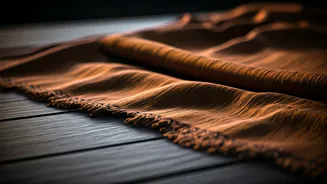
From Maharashtra, we highlight the Karvath Kati, a saree often overshadowed by the more celebrated Paithani. Weavers in the Vidarbha region are striving to keep this art alive. Crafted from pure, wild Tussar silk, the Karvath Kati derives its distinctive name from its geometric borders, which strikingly resemble saw teeth. This weave emanates a brilliant, raw elegance, possessing an earthy charm that sets it apart effortlessly from the heavily embellished silks commonly seen. Its understated beauty and natural sheen make it a unique statement piece, embodying a grounded yet sophisticated aesthetic that speaks volumes without overt ornamentation.
Karnataka's Reversible Marvel
The Patteda Anchu, originating from North Karnataka and tracing its lineage back to the 10th century, is a remarkable example of ancient sustainable design. This substantial cotton saree is characterized by a prominent mustard or red border set against a checked body. Its most ingenious feature is its complete reversibility, allowing it to be worn equally well on either side. Furthermore, it requires no additional fall, lining, or ironing, making it exceptionally low-maintenance. While the influx of inexpensive synthetic fabrics caused it to recede from rural markets, the Patteda Anchu stands as an unparalleled icon of eco-friendly, zero-maintenance clothing, demonstrating timeless practicality and resourcefulness.
Telangana's Storytelling Motifs
The Siddipet Gollabhama is a saree that literally weaves narratives into its very fabric. It showcases intricate motifs depicting a 'Gollabhama,' a milkmaid, gracefully carrying a pot. These are not appliquéd or embroidered post-weaving; rather, the skilled artisans meticulously incorporate them directly into the textile using a complex extra-weft technique. This method is extraordinarily labor-intensive, and the insufficient remuneration for such slow, detailed artistry is causing younger generations to abandon the craft. The Gollabhama saree thus represents a profound cultural tradition facing the threat of extinction due to economic pressures on its practitioners.
Aurangabad's Himroo Blend
Originating from Aurangabad with historical ties to the Mughal era, Himroo is an ingenious fusion of silk and cotton. The name itself derives from the Persian word 'Hum-ruh,' meaning 'similar,' referencing its likeness to pure silk. This fabric offers the opulent appearance of heavy brocade while remaining remarkably breathable, making it perfectly suited for the intense Indian climate. Regrettably, the market is now inundated with cheaper power-loom imitations, often deceptively marketed as genuine Himroo. The authentic Himroo saree provides a luxurious feel and visual appeal without compromising on comfort, a true testament to its historical innovation.
Gujarat's Permitted Comfort
In Patan, Gujarat, weavers developed Mashru, a fabric whose name means 'permitted' in Arabic. This innovative weave was conceived to address religious injunctions that prohibited Muslim men from wearing pure silk directly against their skin. The solution was a masterfully constructed textile featuring a luxurious silk exterior paired with a soft, comfortable cotton interior. This unique construction achieves the ultimate 'comfort-luxury' blend. However, the availability of genuine handwoven Mashru is exceedingly rare today, with most available options being machine-made imitations, diminishing the presence of this culturally significant and ingeniously designed fabric.