




The Asteroid Routing Puzzle
Embarking on a journey to visit multiple asteroids presents a formidable navigational challenge, far more intricate than planning a trip to static locations.
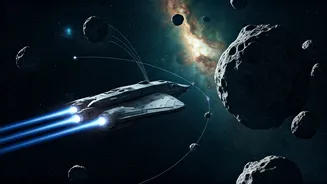
Unlike a salesperson visiting fixed towns, spacecraft must contend with celestial bodies that are in perpetual motion. This dynamic environment makes calculating the most efficient route exceptionally difficult. The core of this problem lies in determining the optimal sequence for visiting these moving targets while minimizing both the total travel duration and the amount of fuel expended. This is the essence of the 'Asteroid Routing Problem' (ARP). Calculating the precise travel time and cost between any two asteroids involves solving a complex optimization problem known as Lambert's problem, which itself dates back to the 18th century. When extended to multiple asteroids, the computational burden escalates dramatically, as every potential path and every pair of objects must be analyzed.
A Smarter Way to Map Routes
To tackle the ARP's complexity, researchers Isaac Rudich and Michael Römer developed an innovative technique by adapting a concept known as Decision Diagrams. These are an evolution of Decision Trees, which visually represent decision-making processes. In a Decision Diagram, instead of mapping every single decision path, multiple paths that lead to the same outcome in terms of time and space are consolidated into a single point. This simplification drastically reduces the number of Lambert's problem calculations required, making the overall planning process more efficient. This refined method has demonstrated impressive results, achieving solutions that are approximately 20% more efficient than traditional approaches, especially for missions involving a larger number of destinations. This 20% improvement is a combined metric of reduced travel time and lower fuel usage, representing a significant advancement in mission planning capabilities.
Real-World Missions & Potential
Missions that venture to multiple asteroids are relatively rare but highly significant for scientific discovery. NASA's Dawn mission, for instance, successfully visited both Ceres and Vesta. More recently, the Lucy mission is undertaking an ambitious journey to study Jupiter's Trojan asteroids, with several flybys of the Asteroid Belt as part of its trajectory. While applying this new mathematical approach to the exact plans of missions like Lucy would be an interesting endeavor, the researchers acknowledge that their model, termed the Asteroid Routing Problem (ARP), is a somewhat idealized representation of astrodynamics. Real-world missions often involve numerous additional factors not accounted for in their simplified model. Nevertheless, even a modest improvement of just 1% in efficiency would translate into substantial savings in time, resources, and fuel for these costly space endeavors. The underlying principles of this approach also hold promise for terrestrial applications, such as optimizing bus routes, supply chain logistics, and shipping networks, where dynamic elements like traffic and weather introduce similar complexities.