






From Waste to Waterway
Many Indian urban waterways suffer from severe pollution, becoming veritable dumping grounds for plastic and household waste, rendering them stagnant and dysfunctional.
A particular 3-kilometer segment of the Buckingham Canal in Tamil Nadu's Cuddalore district mirrored this grim reality, its waters obscured by a dense layer of debris and its flow reduced to a trickle. This once-vital artery had ceased to function as a channel for water, instead becoming a repository for the city's discarded materials. However, this particular stretch defied the typical narrative of environmental decline. It became the site of an ambitious restoration project spearheaded by the Tamil Nadu Forest Department, aiming to reintroduce life and ecological balance to this neglected area.
Planting the Future
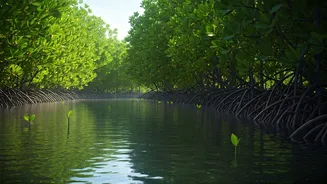
The transformation of the Buckingham Canal involved a significant ecological intervention: the establishment of Chennai's third mangrove forest. Between 2025 and 2026, a total of 20,000 mangrove seedlings were planted across a 20-hectare area along the canal's banks. This extensive planting effort was supported by an ingenious 'fishbone' irrigation system, a design that ensures crucial tidal flow necessary for the healthy growth of mangrove saplings. This intricate network comprises 8 main 'fishbone' channels, augmented by 8 feeder canals and an impressive 186 distribution channels. This well-engineered water circulation system guarantees that the young mangrove plants receive adequate hydration and nutrients, fostering their development into a robust coastal defense and ecosystem.
Community Cleans Up
The impetus for the canal's revival came directly from addressing its most glaring issue: the overwhelming accumulation of waste. A dedicated group of approximately 600 villagers from the local community took it upon themselves to manually clear the canal. Through sustained effort, they managed to remove an astonishing 750 kilograms of plastic debris from the waterway. This arduous task was carried out directly in the polluted water, demonstrating a powerful commitment to restoring their environment. The collected waste was then properly handed over to the Killai Town Panchayat for appropriate disposal. This crucial first step of waste removal paved the way for subsequent restoration activities.
Restoring Flow and Life
Following the extensive waste removal, the canal underwent a critical phase of restoration. This involved desilting and excavating the canal bed to re-establish its original capacity for carrying water. Simultaneously, a diverse array of mangrove species, including _Rhizophora mucronata, Rhizophora apiculata, Avicennia marina,_ and _Avicennia officinalis_, were planted along both sides of the revived canal. These resilient trees play a vital role in stabilizing shorelines, enhancing water movement, and gradually rebuilding the surrounding ecological habitat. The impact of this multi-faceted approach is already becoming apparent, with improved water circulation reaching the Pichavaram mangroves and contributing to a stronger, healthier ecosystem, which is crucial for the livelihoods of local fishing communities.
A Model for Cities
The successful rejuvenation of this Buckingham Canal stretch offers a compelling blueprint for other urban centers grappling with similar environmental challenges. Unlike many restoration projects that prioritize visible planting first, this initiative correctly sequenced its actions: waste removal and flow restoration preceded the planting phase. This methodical approach, coupled with significant community participation, ensures the long-term viability of the project. The ongoing care and maintenance of the mangroves, along with keeping the canal clear of future debris, are essential to prevent a relapse into neglect. This case study demonstrates that a simple, people-centric strategy can effectively bring dying waterways back to life, providing valuable lessons for cities across India.