






A Mile Above
On November 9, 2024, German highliner Friedi Kühne achieved a monumental feat, setting a new world record for the highest highline walk. Suspended a staggering
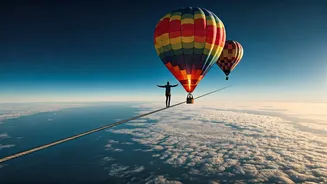
8,202 feet above ground, Kühne traversed a 62-foot slackline strung between two tethered hot air balloons. Strapped with a parachute for safety, the experience was an intense dance with gravity and perception. The initial step onto the line ignited a potent adrenaline rush, swiftly transitioning into a profound flow state. This altered state of consciousness sharpened his senses, dissolving the past and future, and anchoring him solely in the present moment of survival. Adrenaline, when not succumbing to panic, serves as a powerful ally, enhancing alertness, strength, and the capacity to react swiftly to any shift in balance or external force. This extraordinary ascent pushed the boundaries of human endurance and courage in the most visually dramatic of settings, a testament to Kühne's dedication to extreme aerial pursuits and his unique approach to conquering fear.
Navigating Dynamic Anchors
While Kühne has previously navigated much longer slacklines, often without a safety leash, this particular challenge presented unprecedented difficulties due to the nature of the anchors. Unlike static points such as trees or buildings, the slackline was attached to two hot air balloons, which were inherently unstable. These balloons moved independently, drifting up and down, swaying side-to-side, and even rotating. The constant, unpredictable motion amplified the instability of the already dynamic slackline. At one point, the rapid spinning of the balloons caused the entire horizon to shift dramatically, disorienting Kühne and threatening his balance. The slackline's tension also fluctuated, becoming both taut and slack, demanding an even greater degree of focus and control. This experience underscored the difference between walking on a fixed line and a line tethered to volatile, airborne vessels, pushing his ability to maintain equilibrium under extreme duress.
The Art of Highlining
Highlining, in essence, involves tensioning a flat webbing, typically made from durable nylon or polyester, between two elevated anchor points. Unlike the rigid, static nature of a tightrope, a slackline is inherently flexible and reactive, requiring constant, dynamic adjustments to maintain balance. When this activity takes place at heights where a fall could result in severe injury or fatality—generally considered 30 feet or more—it is classified as highlining. The concept for Kühne's record-breaking balloon highline originated a decade prior, in 2014, when he and fellow slackliner Lukas Irmler aimed to set the record for the highest slackline. The primary obstacle throughout this decade-long endeavor was assembling a competent team and finding pilots willing to participate. The setup involved rigging the 62-foot slackline with the balloons in close proximity, stretching between their gondolas. While line length itself wasn't the main concern, coordinating the balloons' positioning, managing their gas burners, and accounting for ballast in each basket proved to be complex logistical challenges. A crucial safety measure was the installation of a quick-release system, enabling pilots to instantly decouple the line if necessary, thereby preventing the slackliner from being caught between the separating balloons.
Mindset and Mastery
The ability to excel at slacklining, particularly in its highlining variations, is a blend of innate talent and diligent practice. While some individuals may possess a natural predisposition for balance and focus, these attributes can also be cultivated through dedicated training. Kühne's own progression began with walking slacklines over water, where falls, though impactful, were not life-threatening. As his confidence and skill grew, he gradually increased the height, escalating the stakes from mere physical injury to the ultimate consequence of mortality. Over roughly a decade, he has accumulated numerous records, including achievements in blindfolded and free-solo highlining. The dynamic nature of the sport means records are frequently surpassed, as athletes continuously push the boundaries. He once held the record for the longest slackline, walking a span just shy of two miles, a feat that more than doubled the previous record. However, this experience involved falls and remounts, preventing it from being counted as a continuous traverse. The pursuit of progression is constant, with athletes eager to innovate and extend their capabilities within this relatively nascent discipline.
The Flow State Explained
Slacklining, much like other athletic pursuits, necessitates a certain degree of natural aptitude. Beyond inherent talent, it demands rigorous training in coordination, physical conditioning, and agility. The very act of maintaining balance on a narrow strip of webbing, often at significant heights, requires profound passion and an unwavering dedication to the sport. Equally important is fostering a strong connection with the slacklining community, as these ambitious endeavors are rarely undertaken in isolation. The core question underpinning these extreme activities is 'Why?' For Kühne, the motivation stems from a deep-seated need to validate his own capabilities, both internally and to the outside world. This validation cultivates enhanced self-confidence and a liberating sense of freedom—freedom from the pervasive grip of fear. It is the freedom to reach a psychological state where giving up or succumbing to failure becomes an inconceivable option. In this elevated mental space, one experiences a profound sense of lightness and augmented strength, a feeling that is exceptionally difficult to articulate fully.
Lessons from the Abyss
Many of the profound experiences and lessons learned throughout Kühne's 15-year highlining career are chronicled in his book, 'Above the Abyss: Finding Strength, Stillness, and Survival on the Slackline.' The book revisits his adventures across vast canyons and between towering skyscrapers, offering an intimate look at his journey. More broadly, it serves as an exploration of courage and the unwavering pursuit of one's aspirations. Whether it's free solo highlining, whitewater kayaking, rock climbing, or base jumping, many of these extreme sports are relatively recent inventions. Kühne posits that they offer a vital means of reconnecting with fundamental human emotions, echoing the survival instincts and triumphs experienced by our ancestors. It's about confronting and conquering challenges that, at first glance, appear utterly insurmountable, ultimately leading to a powerful sense of accomplishment and self-discovery.