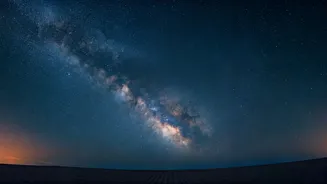







Leo: The Lion's Celestial Roar
Leo, a constellation that strikingly resembles its namesake, offers a fantastic starting point for amateur astronomers. Visible in the southern sky after
sunset, its recognizable pattern begins with a backward question mark, representing the lion's head, with the bright star Regulus marking its base. This asterism is also known as the Sickle of Leo. Extending eastward from this head, a triangle of stars completes the formation, depicting the lion's hindquarters. Leo holds significant seasonal importance; its prominent position in the southern sky after dark signifies the arrival of spring in the Northern Hemisphere. Furthermore, its location along the ecliptic, the sun's apparent path through the sky, makes it a frequent celestial companion to both the moon and planets. Mastering the identification of Leo provides a constant, reliable anchor for navigating the spring night sky, a valuable reference point that endures with practice.
Sidewalk Stargazing Secrets
Serious stargazing often conjures images of remote dark-sky locations, specialized equipment, and extended travel. However, connecting with the cosmos doesn't necessitate such elaborate preparations. While dark skies and telescopes are undoubtedly beneficial, the limitations of urban light pollution shouldn't deter you from observing. The key to unlocking the night sky, even from your immediate surroundings, lies in consistent, short learning sessions. Regularly familiarizing yourself with the positions of the brightest stars and constellations, even in a less-than-ideal setting, builds a foundational knowledge. This practice allows you to appreciate more complex celestial phenomena when you eventually find yourself under a truly dark sky, preventing disorientation. By actively challenging yourself to identify objects without familiar backyard landmarks, you train your observational skills, learning to navigate the vastness of space with confidence. The philosophy is simple: seize every opportunity to look up and learn.
Your Weekly Stargazing Plan
A practical approach to learning the night sky involves a modest, regular routine. Dedicate about ten minutes each evening, shortly after sunset, to a brief scan of the sky. The aim is consistency rather than duration, and no specialized equipment is needed, though apps can be used if you encounter difficulties. Begin by observing the moon's movement and position over successive nights. Then, locate Leo in the southeast, using the star Regulus as your guide. From Leo, shift your attention northward to find the Big Dipper, also known as the Plough. This simple, focused observation plan is easily adaptable; if clouds obscure your view or if you feel tired, simply pause and resume the next night. The most crucial element is regularity, fostering a habit of regular engagement with the celestial sphere, even amidst urban light pollution, which still allows brighter stars to be visible on clear nights. This consistent exposure, even in average conditions, is far more effective than sporadic, lengthy observation sessions.
Ursa Major's Hidden Feet
The famous Big Dipper, or Plough as it's known in the UK, serves as an excellent guidepost in the spring night sky for Northern Hemisphere observers. In April, it typically rests at the zenith, the point directly overhead. This familiar ladle-like shape is part of the larger constellation Ursa Major, the Great Bear. While the Dipper itself is striking, the complete Great Bear offers a more complex and rewarding challenge, particularly its 'feet,' which are marked by wide double stars: Talitha and Alkaphrah, Alula Borealis and Australis, and Tania Borealis and Australis. The Dipper's handle, formed by four stars including Mizar and Alioth, also leads to the Ursa Major Arc, a vast circular pattern spanning 30 degrees in the northern sky. This arc is believed by astronomers to be a shockwave from an ancient supernova explosion that occurred over 100,000 years ago. Identifying these distinct features, especially the double-starred feet, adds another layer of depth to your stargazing endeavors.
Celestial Dance of Moon and Planets
This week presents an excellent opportunity for engaging in sidewalk stargazing, especially with the prominent presence of the moon and visible planets. Around dusk, and particularly after sunset, look towards the western sky for a dazzling trio. The moon, currently bright and heading towards its full phase on May 1 (the Flower Moon), will be a dominant feature. Alongside it, Jupiter will be clearly visible, and slightly below and to the north of Jupiter, you'll spot the ever-bright Venus. These celestial bodies are remarkably resilient to light pollution, making them easy to find even from densely populated urban areas. Their alignment allows you to observe the ecliptic, an imaginary line tracing the sun's path across the daytime sky and the path most planets and the moon follow. Recognizing this celestial highway provides a framework for understanding planetary movements and the fundamental structure of our solar system. By connecting these bright objects, you can conceptually draw the ecliptic across the sky, gaining a deeper appreciation for the solar system's orbital plane.