







Valley Unfolds Gracefully
As the train ventures south from Srinagar, the Kashmir Valley reveals its serene beauty in a tapestry of water, willow trees, and soft mountain light.
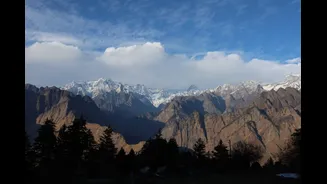
Near Pampore, vast saffron fields, bordered by stately poplar trees, emerge, with glistening streams of meltwater paralleling the tracks. The landscape then transitions to charming apple orchards interspersed with rural homes, while flooded paddy fields capture the morning sun, shimmering like sheets of silver. In clearer moments, the distant, snow-capped peaks of the Pir Panjal range seem to glide alongside the train, offering a dynamic panorama. Villages, appearing unexpectedly between groves of walnut trees and orchards, soon recede behind the gentle curves of the route. The mountain horizons are softened by low-hanging clouds, and fleeting glimpses of ancient shepherd trails and grazing lands become visible on the slopes, painting a picture of pastoral tranquility before the journey moves towards more dramatic terrain.
Mountain's Embrace Tightens
Approaching Qazigund, the environment undergoes a noticeable shift. The air becomes crisper, and the open fields gradually give way to slopes densely covered in pine trees. The rivers narrow into swift-flowing channels, and the mountains begin to loom closer, creating a sense of being enveloped. The train then enters the significant Banihal tunnel, burrowing beneath the Pir Panjal range. Upon emerging, passengers are greeted by a starkly different landscape: the gentle valley gives way to steep, rugged mountainsides etched with the scars of landslides and dense, untamed woodlands. Far below, rivers rush through rocky gorges, their waters adopting a muted green hue under the afternoon sun. At strategic points, passengers are treated to breathtaking views of the train itself, its coaches appearing to glide across immense bridges suspended high between the mountain peaks, a testament to human engineering amidst natural grandeur.
Engineering Marvels Emerge
Despite the dramatic external scenery, the interior of the train maintains an exceptionally smooth ride. Families, like a young couple pointing out passing mountains and tunnels to their child, transform the journey into a cherished memory-making experience. As the train progresses southward, tunnels are encountered with increasing frequency, appearing almost without notice. For some, like Gagan, a soldier from Haryana, the railway offers more than just convenience; it represents a crucial connection to family. He expresses profound gratitude for the train, emphasizing its role in allowing him to return home in time for the birth of his first child, a sentiment that highlights the train's personal significance beyond its utility. Later, the train reaches a highly anticipated engineering feat: the Chenab Rail Bridge. This arch bridge, standing as the world's highest at 1,178 ft, commands the attention of everyone onboard. Conversations pause, and passengers instinctively reach for their phones to capture the vast gorge and the towering mountains on either side. Even those previously disengaged look up, captivated by the spectacle as the train traverses this monumental structure.
Certainty Over Uncertainty
For many, like Dharmendra Singh, who has served 16 years in J&K, the Chenab Bridge symbolizes a significant improvement in travel. He notes that journeys to Jammu previously consumed a substantial portion of his limited leave, but the train now offers a far more accessible and comfortable option, alleviating concerns about road travel and facilitating family visits. The train's journey also brings a welcome sense of reliability, a stark contrast to the precarious travel conditions that once defined access to Kashmir. For decades, the highway was the sole artery, vulnerable to snowfalls and landslides, causing unpredictable delays. Sajad Ahmad, a Srinagar-based travel agent, recounts the discomfort of dusty, bumpy road journeys, emphasizing the new 'luxury of certainty' provided by the train. This predictable travel experience is invaluable, especially as the train approaches its destination, Shri Mata Vaishno Devi Katra, a significant pilgrimage site, where arriving pilgrims and departing passengers alike capture the memorable scene of the train.
A New Era Dawns
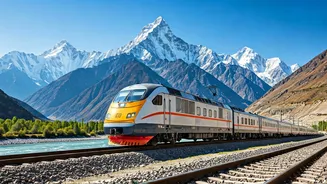
The Vande Bharat Express signifies a monumental shift, fulfilling a long-held aspiration for rail connectivity to Kashmir. Until its recent augmentation, travel into the valley was largely dictated by the unpredictable nature of National Highway 44, prone to disruptions from landslides and snowfall. This new train service, operating a 20-coach configuration, has transformed a potentially arduous journey into a predictable and comfortable four-hour ride. The Udhampur-Srinagar-Baramulla Rail Link (USBRL) project, conceived in the late 1990s, was intended as a crucial strategic and civilian lifeline, but its progress was fragmented. Initial sections opened in phases, with the Banihal-Qazigund link in 2013 being pivotal for internal connectivity. However, the final connection to the broader Indian railway network remained elusive until the completion of this vital link, finally integrating Kashmir into the national rail system and replacing travel anxiety with assurance. The train's bright, cool interiors and wide seats offer passengers a comfortable vantage point to absorb the unfolding green vistas of South Kashmir, turning the journey itself into an integral part of the travel experience.