






IPO Filing Details
SpaceX has officially initiated the process for its Initial Public Offering, a move long anticipated in the financial and aerospace sectors. The company
submitted its documentation to the U.S. Securities and Exchange Commission, marking a significant step towards a public listing on the Nasdaq exchange, potentially by mid-June. While the initial filing, known as an S-1 form, doesn't typically include specific figures like the number of shares offered or their exact price, these details are expected to be finalized closer to the actual IPO date. Reports suggest SpaceX aims to raise a substantial amount, with valuations reportedly hovering around $2 trillion. This public offering aims to fuel the company's already aggressive expansion and development across its diverse business units, enabling greater access to capital for its ambitious projects and solidifying its position in the market.
Financial Performance Snapshot
The company's IPO filing has shed light on its financial health, revealing figures previously kept private. For the year 2025, SpaceX reported impressive revenues of $18.7 billion, accompanied by an adjusted EBITDA of $6.6 billion. The momentum continued into the first quarter of 2026, where the company generated $4.7 billion in revenue and achieved an adjusted EBITDA of $1.1 billion. These figures underscore a robust growth trajectory and strong operational performance across its various ventures. The detailed financial breakdown illustrates the company's capacity to generate significant income and manage its operations effectively, laying a strong foundation for its public market debut and future endeavors.
Sectoral Financial Breakdown
SpaceX's financial results are strategically divided into three core segments: Space, Connectivity, and AI. The Space segment, encompassing launch services and related operations such as the Dragon spacecraft, brought in $4.1 billion in revenue in 2025 and $619 million in the first quarter of 2026, with a positive adjusted EBITDA of $653 million in 2025, though it experienced a negative adjusted EBITDA of $351 million in Q1 2026. The Connectivity segment, largely driven by its Starlink satellite internet service, represents the largest contributor to revenue and earnings, generating $11.4 billion in 2025 and $3.3 billion in Q1 2026, with adjusted EBITDA of $7.2 billion and $2.1 billion respectively. Starlink's subscriber base has seen substantial growth, reaching 10.3 million by the end of Q1 2026, a significant increase from 5.0 million a year prior. The newly formed AI segment, bolstered by the acquisition of xAI, recorded $3.2 billion in revenue for 2025 and $818 million in Q1 2026, but incurred adjusted EBITDA losses of $1.2 billion and $609 million for the respective periods.
Starship Development Investment
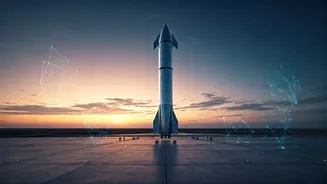
A substantial portion of SpaceX's capital is being channeled into the development of its revolutionary Starship vehicle. The company disclosed investments of $3 billion in Starship development during 2025 and an additional $930 million in the first quarter of 2026. These significant expenditures highlight the strategic importance of Starship to SpaceX's long-term objectives. The company anticipates that Starship, which is slated for its 12th suborbital test flight imminently, will commence satellite launches in the latter half of the current year. This ongoing investment signifies SpaceX's commitment to pushing the boundaries of space transportation and enabling ambitious future missions, including interplanetary travel and large-scale orbital infrastructure.
AI Segment Growth and Investment
The Artificial Intelligence segment, significantly enhanced by the recent acquisition of xAI, is a focal point for substantial research and development investment. SpaceX allocated a notable $12.7 billion to R&D in this sector during 2025 and continued with $7.7 billion in the first quarter of 2026. This aggressive investment strategy in AI is directly linked to the company's perception of immense market opportunities. SpaceX projects a total addressable market (TAM) of $28.5 trillion, with the AI segment alone accounting for a colossal $26.5 trillion, primarily within enterprise applications. This strategic focus underscores SpaceX's belief in AI's potential to revolutionize industries and unlock unprecedented economic growth.
Vision for Orbital Data Centers
SpaceX's ambitious plans extend to the establishment of orbital data centers, a concept designed to leverage the unique advantages of space for advanced computing. The company has stated its intention to begin launching spacecraft for these orbital data centers as early as 2028, acknowledging that considerable developmental work remains. SpaceX asserts its unique position to deploy and manage these facilities in orbit, anticipating that, over time, they will achieve lower operational costs than terrestrial data centers. This is attributed to their integrated expertise in launch capabilities, large-scale satellite manufacturing, network connectivity, and terrestrial data center operations. The realization of orbital data centers is seen as a crucial step towards enabling transformative breakthroughs and creating new trillion-dollar markets beyond Earth.
Future Markets Beyond Earth
SpaceX envisions its current space endeavors as catalysts for radical transformations across terrestrial industries and the genesis of new, multi-trillion-dollar markets on celestial bodies like the Moon and Mars. The company's forward-looking perspective includes potential markets such as point-to-point travel, space tourism, in-orbit manufacturing, resource extraction and energy production on other planets, and asteroid mining. SpaceX explicitly states its distinct capability to identify, cultivate, and commercialize these previously non-existent markets. By pioneering breakthroughs in spaceflight, global connectivity, and artificial intelligence, SpaceX aims to usher in an era of abundance, driving unprecedented expansion of the global economy.