



Mountain's Ghostly Sentinel
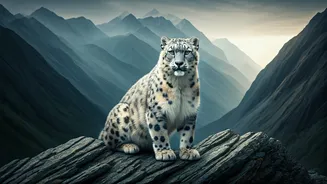
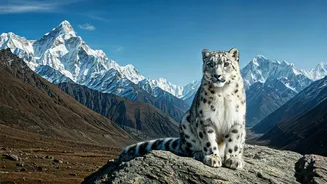
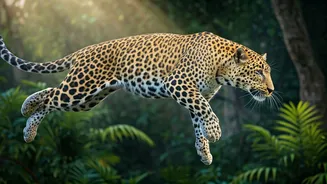
High in the remote, rugged peaks of Central and South Asia, including the majestic Himalayas, resides the snow leopard. This magnificent feline, often
dubbed the "ghost of the mountains," possesses a remarkable smoky-grey coat adorned with dark rosettes that provide unparalleled camouflage against the rocky, snow-dusted terrain. Snow leopards are solitary and exceptionally stealthy hunters, preferring vast, inaccessible landscapes far from human activity. Even seasoned researchers dedicate months to tracking these elusive predators, with photographic evidence often captured through patient camera trap monitoring, making each confirmed sighting a significant achievement for conservation efforts and a thrilling testament to their hidden existence.
The Mythical Asian Unicorn
Hailing from the dense forests of Laos and Vietnam, the saola is an exceptionally rare large mammal, so elusive it was only officially documented by science in 1992. Revered as the "Asian unicorn" due to its near-mythical status, this creature sports elegant, long, straight horns and distinctive white markings on its face, giving it an almost ethereal appearance. Sightings of live saolas in their natural habitat are incredibly scarce, and none have ever been successfully kept in captivity. The ongoing threats of habitat destruction and hunting have further contributed to its mysterious aura and made encounters exceedingly infrequent, solidifying its place as one of Earth's most enigmatic animals.
Rainforest's Striped Secret
The okapi, an animal resembling a blend of a zebra and giraffe, is actually the closest living relative to the giraffe and inhabits solely the dense, verdant rainforests of the Democratic Republic of Congo. These animals are inherently shy and possess a secretive disposition, making them notoriously difficult to observe. Their dark, velvety coats allow them to blend seamlessly into the dappled shadows of the forest, while the striking stripes on their legs serve as a form of visual disruption to potential predators. Due to their remote dwelling and natural avoidance of human presence, the okapi remained unknown to Western science until the early 20th century, a testament to their deep forest seclusion.
Scaly, Nocturnal Wanderer
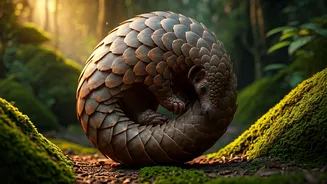
Covered from head to toe in protective keratin scales, the pangolin stands out as one of the world's most unusual mammals and simultaneously one of its most challenging to locate. Primarily active during the night, pangolins lead highly secretive lives, and their primary defense mechanism is to curl into a tight, impenetrable ball when sensing danger. Found across both Asia and Africa, these fascinating creatures typically spend their days concealed within burrows or hidden beneath thick forest undergrowth. Tragically, pangolins are also among the most heavily trafficked mammals globally due to the insatiable demand for their scales in illegal wildlife markets, making any glimpse of them in their natural environment an increasingly rare privilege.
Frozen Forest's Rare Cat
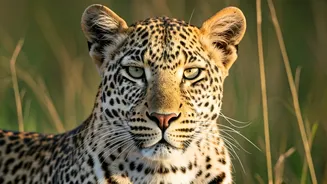
The Amur leopard, renowned as one of the planet's most endangered big cats, inhabits the cold, snowy forests located in the Russian Far East and northeastern China. Unlike many of its leopard relatives, this species has adapted remarkably to survive harsh, wintry climates. Their hunting activities are predominantly carried out under the cover of darkness, and they roam across vast territories, which significantly reduces the probability of human encounters. With estimates suggesting fewer than a few hundred individuals remain in the wild, spotting an Amur leopard is considered an extraordinary, once-in-a-lifetime event, even for dedicated wildlife researchers and conservationists.
Madagascar's Eerie Primate
Native exclusively to the island of Madagascar, the aye-aye is a unique nocturnal lemur distinguished by its peculiar appearance. It features large, expressive eyes, prominent, bat-like ears, and a remarkably elongated middle finger. This specialized digit is crucial for its foraging method, where it taps on tree bark to locate insect larvae and then extracts them. Because the aye-aye is active only after sunset and resides deep within forested regions, it is seldom seen by humans. Furthermore, local folklore and myths have historically instilled fear surrounding the species, unfortunately leading to persecution and further diminishing opportunities for observation.
Flightless Parrot's Camouflage
The kakapo, originating from New Zealand, is a substantial, flightless parrot recognized as one of the rarest avian species globally. This bird is predominantly active at night, lives on the ground, and exhibits extreme shyness. In contrast to the vibrant plumage typical of many parrots, the kakapo boasts moss-green feathers that provide exceptional camouflage amongst the forest foliage. Conservationists meticulously monitor every surviving kakapo, and sightings are generally restricted to the scientists directly involved in the bird's dedicated recovery programs, making public encounters virtually non-existent.
Ocean's Enormous Enigma
Few creatures on Earth evoke as much mystery as the giant squid. Dwelling in the profound depths of the ocean, often thousands of feet beneath the surface, this colossal marine animal remained largely the stuff of legend for centuries. The primary evidence for its existence came from deceased specimens that washed ashore or were discovered within the stomachs of whales. It wasn't until recent decades that scientists managed to capture the first visual records of live giant squids thriving in their natural, abyssal environment, underscoring their status as one of the planet's least observed inhabitants due to their extreme deep-sea habitat.