


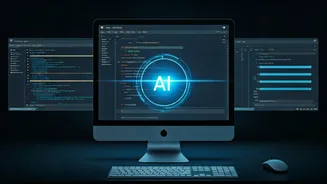

Stitch: An AI Design Partner
Google has introduced significant updates to Stitch, an experimental AI-powered platform designed to generate user interfaces from both textual descriptions
and visual inputs. This advancement highlights the increasing integration of artificial intelligence within creative and design workflows. Stitch, developed by Google Labs, functions as a 'vibe design partner,' suggesting a move towards more automated and conversational approaches to application development. The recent enhancements to Stitch have garnered considerable attention within the design community. Notably, following the increased buzz around Stitch, shares for Figma, a widely used collaborative design platform, reportedly experienced a decline of 8.8% on March 18th. Google is positioning Stitch as an increasingly autonomous design assistant, equipped with features intended to facilitate the creation, refinement, and prototyping of interfaces with minimal manual intervention from the user. Early demonstrations and user feedback indicate capabilities such as AI-enhanced design canvases, iterative design based on prompts, and accelerated prototyping processes. Although Stitch remains in its experimental phase, its innovative approach demonstrates how AI-native tools might begin to interface with existing platforms like Figma, potentially altering the competitive landscape.
Understanding Stitch's Functionality
Launched in May 2025, Stitch is Google's novel approach to user interface (UI) design, aiming to bridge the gap between a designer's vision for intuitive interfaces and a developer's ability to translate those concepts into functional code, thereby reducing manual effort. The platform leverages the advanced multimodal capabilities of Gemini 2.5 Pro to foster a more seamless integration between the design and development stages. Stitch allows users to refine designs using image inputs, features an interactive chat interface, theme selection options, and the ability to paste designs directly into Figma. Essentially, users can articulate their desired application in plain English, specifying elements like color schemes and the intended user experience, and Stitch will generate a visual interface that aligns with these specifications. Furthermore, Stitch can create UIs from images or wireframes; users can upload a design sketch, a UI screenshot, or a rough wireframe, and the platform will process it to produce a digital UI. It also offers the flexibility to generate multiple interface variations, enabling users to explore different layouts, components, and styles.
Stitch vs. Figma Dynamics
In contrast, Figma stands as a professional-grade UI/UX design platform renowned for its precision and robust design system capabilities, initially launched in 2012. It offers a web-based collaborative application primarily focused on user interface and user experience design, emphasizing real-time collaboration. Stitch is emerging with features that parallel Figma's core offerings, potentially positioning it as a competitor. The latest updates to Stitch enhance its adaptability by accepting diverse input types, including images, text, and code. A new design agent is capable of analyzing comprehensive project histories and concurrently tracking numerous design trajectories. The platform now incorporates prototyping functionalities, transforming static designs into interactive prototypes. Enhanced voice commands enable real-time design modifications directly through spoken instructions on the canvas. Additionally, through the Model Context Protocol server, Stitch facilitates integration with external development tools. The substantial updates to Stitch, reportedly impacting Figma's stock value, signify a broader trend of AI-driven companies entering domains previously dominated by specialized software firms. This mirrors recent market shifts where companies like Salesforce and Intuit experienced significant effects after Anthropic introduced new features for its Claude Cowork, rendering some of their core functionalities less essential.
Industry Perspectives Emerge
Industry leaders and product designers have shared their views on Google's Stitch. Jonathan G Blanco, CEO and Founder of Niftmint, views the Stitch update as more than a minor enhancement, describing it as a move towards 'Vibe Design.' He suggests that the traditional method of commencing projects from a blank slate is evolving, with the AI-native infinite canvas allowing users to define objectives, and Gemini 3.1 handling the intricate design execution. Rakshan Vaishnav, a product designer at Zoho, found Stitch to be an enjoyable tool for UI experimentation, noting its ability to interpret mentioned effects and produce visually appealing results due to Gemini's model. However, he views Stitch more as an experimental tool for visual enhancement rather than a direct product-driven output. In contrast, venture capitalist Keshav Lohia expressed a strong opinion on X, forecasting Stitch's long-term impact on Figma, stating that traditional tools will struggle to compete with increasingly competent and collaborative AI-native products. Conversely, some entrepreneurs remain optimistic about Figma's future. David Okeke, a US-based tech entrepreneur, believes that AI will ultimately increase Figma's value, predicting that Figma will emerge as a leader amidst the current AI hype and influencer activity.