



Earthly Expectations Shattered
For a long time, astronomers assumed that planets beyond our solar system would mirror the familiar structure of Earth: a solid metallic core, a rocky
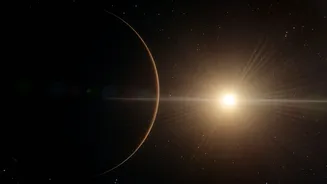
mantle, and a thin atmosphere. This 'rocky planet' blueprint served as our standard model for inferring planetary composition. However, recent research published in The Astrophysical Journal challenges this long-held assumption, particularly concerning the most frequently discovered exoplanets. These worlds, classified as sub-Neptunes, are larger than Earth but smaller than Neptune. Their close relatives, super-Earths, are slightly smaller and are thought to have lost most of their initial hydrogen envelopes. The prevailing theory suggested these planets formed much like Earth, with varying amounts of leftover gas accumulating on top, leading to a layered structure of iron, silicate, and hydrogen. This conventional view is now being questioned by new insights into the extreme conditions found within these alien worlds, suggesting a fundamental divergence from our terrestrial experience. The implications of this revised understanding are profound for how we perceive planetary formation and diversity across the cosmos.
The Hydrogen Conundrum
The conventional model of a distinct metallic core, silicate mantle, and gaseous atmosphere breaks down when subjected to the extreme pressures and temperatures found deep within sub-Neptune planets. At temperatures exceeding 4,000 degrees Kelvin, a surprising phenomenon occurs: hydrogen and molten silicate lose their distinct properties and become fully miscible, meaning they blend together seamlessly like water and alcohol, rather than repelling each other like oil and water. This interaction fundamentally alters the internal architecture of these planets. A new study has meticulously explored the consequences of this miscibility, leading to a startling conclusion about planetary interiors. If a planet accumulates less than approximately one percent of its mass as hydrogen, it will indeed form a recognizable metallic core, similar to Earth. However, if it accrues more hydrogen, the interior transforms into a single, homogenous, and dynamic fluid composed of iron, silicate, and hydrogen, eliminating the distinct layers of core and mantle we typically envision. This blended interior extends almost all the way to the planet's center, a radical departure from our established planetary blueprints.
Explaining Planetary Puzzles
This newfound understanding of sub-Neptune interiors offers compelling explanations for several observed characteristics of exoplanets that previously baffled scientists. The internal structure of a planet profoundly influences its cooling mechanisms, its ability to retain an atmosphere, and how its overall size evolves over cosmic timescales. The miscibility framework presented in the new study successfully accounts for features that traditional 'layered cake' models struggled to reconcile. Notably, it provides a coherent explanation for the 'radius gap,' a peculiar scarcity of planets found in the size range between super-Earths and sub-Neptunes, a phenomenon meticulously mapped by powerful telescopes like Kepler and the James Webb Space Telescope. Furthermore, this model elegantly explains the observed correlation between planet radii and their orbital periods. These relationships emerge naturally when one assumes that young sub-Neptunes harbor a significant portion of their hydrogen within this mixed interior, which is then gradually released into their outer atmospheres as the planets cool and the miscibility region contracts over millions of years. This process effectively causes the hydrogen to bubble out from the planetary interior, impacting their observable characteristics.
Observable Signatures Ahead
The implications of this research extend beyond theoretical models, offering concrete, testable predictions about exoplanetary evolution. The hypothesis that hydrogen is slowly exsolving from a planet's interior into its atmosphere suggests a specific observable signature: young sub-Neptunes should exhibit slower contraction rates than predicted by standard evolutionary models. In simpler terms, they should appear 'puffier' than expected for their age. This crucial prediction becomes verifiable as astronomers begin to discover and study sub-Neptunes orbiting very young stars, some only tens of millions of years old. These 'cosmic toddlers' provide an ideal laboratory for measuring this predicted signature. Upcoming observations from the James Webb Space Telescope and next-generation transit surveys are poised to gather the precise data needed to confirm or refute this aspect of the theory, offering a direct window into the dynamic processes shaping these alien worlds. This provides an exciting avenue for empirical validation of the new models.
Caveats and Bold Claims
While the findings are compelling, it is important to acknowledge the inherent uncertainties and theoretical underpinnings of this research. The model relies on extrapolations of the behavior of hydrogen, silicate, and iron under extreme conditions that are currently beyond direct laboratory replication, although high-pressure experiments are beginning to close this gap. The precise internal heat budgets of these planets also remain somewhat uncertain, and even small inaccuracies in these parameters can propagate and influence the model's predictions. Furthermore, the methodology employed, which involves working backward from observed planetary populations to infer the underlying physics, is statistical in nature rather than definitively deterministic. Nevertheless, the central assertion of the paper is remarkably bold and clear: the most prevalent types of planets in our galaxy may possess internal structures that are fundamentally dissimilar to Earth's. The concept of a distinct, dense metallic core, something we so readily associate with planets, might actually be the exception rather than the rule throughout the universe. In essence, Earth itself could be the outlier in this vast cosmic landscape.