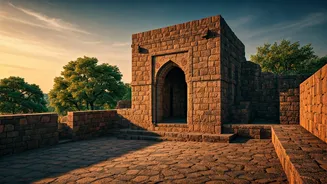









Ancient Echoes of Gondwana
Nestled atop a rocky hill in Jabalpur, Madhya Pradesh, lies the Madan Mahal Fort, a testament to the architectural prowess and strategic vision of the Gondwana
dynasty. Believed to be around 900 years old, this fort is not grand in size but immensely rich in historical significance. Its construction is attributed to the Gond rulers, a prominent indigenous community that held sway over vast territories in central India for centuries. The fort's unique position, overlooking the surrounding landscape, provided an unparalleled vantage point for observing approaching enemies, a crucial element for defense in medieval times. Even today, standing amidst its weathered stone walls, one can almost feel the presence of the past rulers and the vibrant life that once thrived within its confines. It serves as a miniature yet potent reminder of a powerful era in India's history.
Rani Durgavati's Legacy
The Madan Mahal Fort is intrinsically linked to the heroic figure of Rani Durgavati, the formidable queen of the Gondwana kingdom. Her reign, marked by courage and administrative acumen, is a celebrated chapter in Indian history. Although the fort predates her immediate rule, it was undoubtedly a key strategic point during her time and a place where she likely spent considerable time overseeing her kingdom. The fort's proximity to her capital and the tales of her valor in defending her realm from invaders are deeply ingrained in the local folklore. The very stones of Madan Mahal seem to echo the bravery and resilience of this legendary queen who fought valiantly to protect her people and her ancestral lands. Her story continues to inspire, with the fort standing as a silent witness to her indomitable spirit and her significant contribution to the Gondwana dynasty.
Architectural Intrigue and Design
Despite its relatively modest dimensions, Madan Mahal Fort boasts an intriguing architectural design that speaks volumes about the ingenuity of its creators. Built predominantly from stone, the fort features a series of interconnected structures, including watchtowers, courtyards, and what appear to be residential or administrative buildings. The strategic placement of openings and battlements suggests a well-thought-out defense system. One of the notable features is a small water tank, an essential resource for any fortification. The fort's layout, though compact, efficiently utilizes the natural contours of the rocky terrain, blending seamlessly with its environment. This integration of man-made structures with the natural landscape is a hallmark of ancient Indian architecture, and Madan Mahal Fort exemplifies this with its enduring charm and functional design, making it a captivating site for history enthusiasts and architectural admirers alike.