







Unveiling the Lyrids
In April 2026, India will be treated to a stunning celestial performance: the Lyrid meteor shower. This ancient phenomenon, documented for centuries, occurs
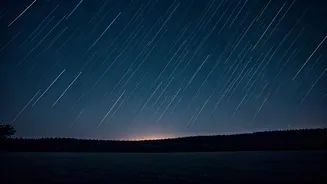
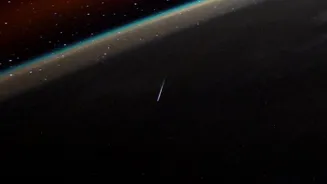
as Earth ventures through the dusty remnants left behind by Comet Thatcher. As these minuscule particles from the comet enter our planet's atmosphere, they burn up, creating brilliant streaks of light that dart across the night sky. The Lyrids are particularly cherished not only for their consistent rate of visible meteors but also for their capacity to produce exceptionally bright "fireballs," an occasional, spectacular flash that leaves a lasting impression on observers. NASA explains that these meteors are intrinsically linked to the long-period comet C/1861 G1 Thatcher, which embarks on its orbital journey around the Sun approximately every 415.5 years. The nature of these meteors means they typically don't leave prolonged glowing trails, but the occurrence of a fireball, a particularly luminous event, is a hallmark of this shower.
Prime Viewing Times in India
For sky gazers in India, the Lyrid meteor shower will be active from around April 16 to April 25, 2026, with its peak intensity anticipated during the night of April 21 and into the early hours of April 22. An additional excellent viewing opportunity is also present on April 23. Under optimal conditions, one could expect to witness between 10 and 20 meteors per hour. The most opportune time for observation in India generally falls between midnight and sunrise, specifically from approximately 12 AM to 5 AM IST. The period between 3 AM and 5 AM is often cited as having the highest visibility. Major cities like Delhi, Mumbai, and Bengaluru, along with their surrounding northern and central regions, are considered favourable locations for enjoying this cosmic event, provided one can escape significant light pollution.
Maximizing Your Viewing Experience
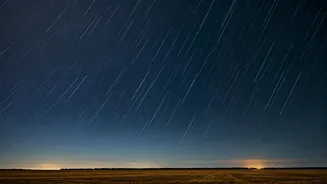
India's location in the Northern Hemisphere places it in a highly advantageous position for observing the Lyrid meteor shower. To make the most of this astronomical spectacle, experts strongly advise seeking out a dark, open environment, far removed from the glare of urban lights and any sources of light pollution. Think of a rural expanse or an unobstructed rooftop with minimal streetlights nearby. NASA's recommendation for an optimal viewing posture is to recline on your back, allowing your eyes a minimum of 20 to 30 minutes to acclimatize to the darkness. While the meteors appear to originate from a point near the constellation Lyra, known as the "radiant," it's best not to stare directly at the star Vega within Lyra. Instead, let your gaze rest slightly away from Lyra, which will allow you to perceive the longer, more graceful streaks of light as they traverse the sky.