







Booster Revival Ignition
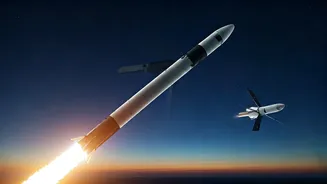
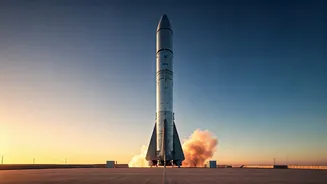
In a significant stride towards sustainable space exploration, Blue Origin has successfully executed a static fire test of its formidable New Glenn rocket.
This crucial event, held on April 16, 2026, involved igniting the rocket's seven first-stage engines for a duration of 19 seconds while the colossal 322-foot-tall vehicle remained firmly secured to the launchpad at Florida's Cape Canaveral Space Force Station. This controlled burn is a vital precursor to the rocket's next mission, designated NG-3, which is slated for launch on Sunday, April 19. What makes this upcoming launch particularly noteworthy is the planned reuse of a booster from a prior flight, a pioneering step for the New Glenn program. The rocket's first stage, designed for multiple uses, has already completed two successful missions, including a test flight in January 2025 and the November 2025 deployment of NASA's twin ESCAPADE probes to Mars. Demonstrating its reusability, Blue Origin successfully landed the first stage on the drone ship "Jacklyn" in the Atlantic Ocean following the ESCAPADE mission.
Engine Upgrades and Future Flights
The booster set to fly on NG-3, though retaining its original structure, will incorporate some refreshed hardware. Blue Origin's CEO, Dave Limp, revealed on Monday, April 13, that for this initial refurbishment, all seven engines on the first stage have been replaced. Additionally, the company took the opportunity to test several upgrades, including a specialized thermal protection system installed on one of the engine nozzles. This strategic approach allows Blue Origin to leverage the engines that performed admirably during the NG-2 mission for subsequent flights, optimizing resource utilization. The company has stated its ambition for each New Glenn first stage to achieve a lifespan of at least 25 flights, a testament to the robust design and engineering behind the rocket. The static fire test is a critical validation of these refurbished engines and the implemented upgrades, ensuring they are ready to perform reliably for the demanding requirements of spaceflight.
Satellite Payload Unveiled
The upcoming NG-3 mission carries a significant payload: a Block 2 BlueBird direct-to-cellphone internet satellite developed by the Texas-based company AST SpaceMobile. This satellite is destined for low Earth orbit (LEO) and represents a substantial advancement in satellite technology. While one Block 2 BlueBird has already experienced space, having been launched aboard an Indian rocket in December, this mission will deploy another unit. These satellites are remarkably large, with the Block 2 variant boasting an impressive antenna span covering a massive 2,400 square feet (223 square meters). This dwarfs the dimensions of their predecessors; earlier Block 1 BlueBirds, five of which have reached LEO, featured antennas that covered 693 square feet (64.4 square meters). The immense size of the Block 2 BlueBird's antenna is crucial for its direct-to-cellphone communication capabilities, aiming to provide seamless connectivity across the globe.