




A Park Apart
Often referred to as the 'Mountains of Florida,' Torreya State Park in the northern part of the state offers a geographical surprise. Unlike the flat landscapes
typically associated with Florida, this expansive 13,000-acre park boasts high plateaus, deep ravines, and picturesque waterfalls, evoking the feel of states further north like Georgia or North Carolina. Established in 1935, making it one of Florida's pioneering state parks, its creation was a significant undertaking by the Civilian Conservation Corps during the Great Depression. The park's unique character is intrinsically linked to the rare torreya tree, also known as the 'stinking cedar,' a species found predominantly on the elevated bluffs overlooking the Apalachicola River. Park Ranger Brian Brown emphasizes the park's ability to offer a complete escape from the outside world, allowing visitors to fully immerse themselves in the natural environment and appreciate its uncommon botanical treasures and rich historical narrative.
Planning Your Escape
Torreya State Park welcomes visitors year-round, operating from 8 a.m. until sunset, and best of all, admission is free. For those without a state park pass, a nominal fee of $3 applies to vehicles and motorcyclists, with cyclists and pedestrians paying $2. It is highly recommended to secure your day pass or state park pass online prior to your visit to ensure a smooth entry. The park is conveniently situated approximately an hour's drive from Tallahassee and about 1.5 hours from Panama City Beach, providing a tranquil escape into wild Florida. Access is primarily via a single road, NW Torreya Park Road, which concludes at the historic Gregory House. A personal vehicle is essential for navigating the park and its surroundings, with access points typically involving Interstate 10 if coming from the west, or Highways 231 and 20 if approaching from the Panama City Beach area.
Seasons of Splendor
The optimal time to visit Torreya State Park depends largely on your desired experience. For those captivated by the vibrant hues of autumn foliage, the period between late October and November is ideal, offering cooler temperatures and a spectacular display of changing leaves, with sweetgum trees often displaying amber and gold. Winter is a popular season, particularly for those who enjoy the cozy atmosphere of crackling campfires and roasting s'mores, making it the busiest time of year according to park rangers. Spring offers a different kind of beauty, with blooming mountain laurels adding splashes of color and providing an excellent opportunity for bird-watching. During this season, visitors may also be fortunate enough to spot several species of hairstreak butterflies, adding to the park's ecological richness.
Adventures Await Outdoors
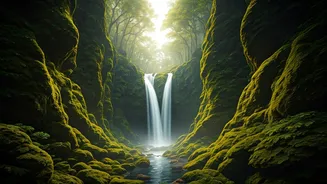
With 16 miles of challenging hiking trails, Torreya State Park is a haven for trekkers. The Weeping Ridge Trail, a relatively short one-mile round trip, descends into a steep ravine, revealing a beautiful 25-foot waterfall, a favorite for families seeking a bit of adventure. For a more extensive exploration, the Torreya Hiking Trail, established by the Florida Trail Association in the 1970s, features two loops. The Rock Creek Loop winds through approximately seven miles of diverse terrain, including ravines, creeks, subtropical forests, and charming footbridges, showcasing new growth on trees like sweetgum, magnolia, oak, and hickory, still recovering from Hurricane Michael in 2018. Keep an eye out for the striking tulip trees with their pale green and orange blossoms. The Torreya Challenge Loop is a seven-mile undertaking that involves steady ascents and descents, meandering across creeks, an old forest road, and through blackberry brambles, culminating on a ridge adorned with blooming mountain laurels in spring and offering the park's steepest incline.
Echoes of History
Torreya State Park holds significant historical echoes, particularly from the Civil War era. For two years, approximately 200 Confederate soldiers occupied the bluffs overlooking the Apalachicola River. A trail leading from the Gregory House guides visitors to the Hammock Landing Battery, where these soldiers maintained a watch to defend against river attacks, thereby protecting a vital manufacturing center in Columbus, Georgia. Though abandoned at the war's end in 1865, the remnants of the cannon emplacements are still discernible in the landscape today. The Gregory House itself is a historical artifact, a 3,000-square-foot structure dating back to 1849. Originally situated on the opposite side of the river, it remained within the same family until the 1930s when it was gifted to the CCC. Its relocation was a monumental seven-year feat, involving meticulous dismantling, river transport by barge, and reconstruction by hand. Guided tours, led by park rangers who possess a wealth of knowledge and stories, are offered Monday through Friday at 10 a.m., and on weekends and state holidays at both 10 a.m. and 2 p.m.
Unique Flora and Fauna
The park's namesake, the torreya tree (or 'stinking cedar'), is a major draw for many visitors. First identified by botanist Hardy Bryan Croom in 1835, this exceptionally rare tree, with only about 200 specimens remaining globally, can be found on the park's bluffs. Saplings are protected by wire mesh along the path to the Gregory House. Tragically, Hurricane Michael in 2018 devastated 80 percent of the torreya trees, but through a collaborative effort between the Florida Park Service and the Atlanta Botanical Garden, seeds from surviving trees are being cultivated and replanted in the park's ravine habitat. Equally significant is the Florida yew, a critically endangered evergreen shrub native to a small area of the Florida Panhandle. Park rangers also highlight the abundance of rare flowers along the trails, such as blazing star. Torreya State Park is also a key stop on the Great Florida Birding and Wildlife Trail, attracting over 100 bird species, including brown-headed nuthatches, yellow-throated vireos, and bald eagles. Early spring offers a chance to spot the endangered mourning cloak butterfly, and the rare Barbour's map turtle, indigenous to this region, is another special inhabitant.
Lodging and Provisions
Torreya State Park offers diverse accommodation options for visitors, whether you plan to immerse yourself in the wilderness or prefer more comfort. The Weeping Ridge family campground provides 30 campsites with full facilities, including restrooms, showers, and picnic areas, each equipped with electricity and water, ideal for those wishing to camp under the stars at one of Florida's highest campgrounds. For a more primitive experience, several scattered primitive campgrounds are also available. For a step up in comfort, the park offers a unique yurt, capable of accommodating up to five people, complete with air conditioning, heating, and a skylight for stargazing, plus a deck for enjoying the views. Additionally, a 'cracker cabin,' a traditional architectural style, can house up to six people and features air conditioning, heating, a queen-size bed, four bunk beds, and dining furniture. It's important to note that while leashed pets are welcome in the park, they are not permitted inside the buildings. Visitors are also reminded to bring their own linens, as they are not provided for the yurt or cabin.
Dining Options
Planning your meals is essential when visiting Torreya State Park, as there are no restaurants or food stores located within or immediately adjacent to the park. Ranger Brian Brown advises visitors to stock up on groceries and any necessary provisions in Bristol, a town situated approximately a 20-minute drive from the park entrance. This ensures you'll have everything you need for your stay, whether you're planning to prepare meals at your campsite or enjoy a picnic. The park does provide convenient picnic tables and charcoal grills at the campsites and within the pavilion area, offering a pleasant setting for outdoor dining amidst the natural beauty of Torreya State Park.