



The Modern Childhood Shift
Contemporary childhood often prioritizes tangible achievements and structured learning over the spontaneous joy of unstructured play. This shift has led
to packed schedules, increased academic expectations from a young age, and a pervasive focus on performance metrics. While parental aspirations are high, it's crucial to question the true cost of this pressure. Decades of observation reveal a move away from delightful exploration towards a childhood driven by constant performance. Factors like early academic demands, incessant digital engagement, and the culture of comparison have fundamentally altered the formative years. Consequently, playtime has diminished, and downtime is often perceived as unproductive. This has resulted in a generation that, while intellectually stimulated, frequently feels overwhelmed and exhausted.
Foundation Building Years
Neuroscience unequivocally states that early childhood is not a race towards academic mastery, but rather a critical period for establishing fundamental building blocks. During these initial years, the brain undergoes its most rapid development. Research from esteemed institutions indicates that approximately 90% of brain development occurs before the age of five, with neural connections forming at an astonishing rate. These crucial connections are not fostered through passive memorization but are ignited by active, immersive, and sensory-rich experiences. When a child engages in activities like manipulating clay, using scissors, or sketching their thoughts with crayons, they are not merely creating art; they are actively involved in profound cognitive processes. These tactile, maker-style activities are instrumental in shaping neural pathways, transforming abstract ideas into tangible expressions. They facilitate the organization of thought, enhance motor coordination, and provide a physical manifestation of imagination. Embracing open-ended creation, whether through drawing to grasp mathematical concepts or journaling with sketches, should be recognized as foundational cognition, not merely an optional extracurricular activity. Creativity is, in essence, thinking made visible. These hands-on engagements cultivate essential executive functions, improve focus, and sharpen problem-solving abilities. They inherently involve planning, sequencing, experimentation, and iterative refinement – the very mental processes that underpin advanced mathematical reasoning and design-thinking skills later in life. When children are provided with the means to create, they are not detracting from learning; they are profoundly deepening it.
Making as Deep Learning
Empowering children with the role of 'makers' – providing them with blocks, paper, and recycled materials to tackle design challenges – significantly strengthens their brain's executive functions and critical thinking capabilities. Drawing transcends being a mere hobby; it's a vital method for processing and understanding the world around them. Similarly, utilizing tools for creation is far more than just play; it’s akin to 'neural engineering,' diligently building the coordination and problem-solving prowess necessary for more complex learning later on. Emotional security, meaningful social interactions, imaginative role-playing, and vibrant creative expression are not distractions from the learning process; they are integral components of it. When we substitute playful exploration with worksheets, we might observe fleeting academic gains, but we inadvertently risk long-term detrimental consequences. These can manifest as heightened anxiety, diminished resilience, struggles with emotional regulation, and a decline in intrinsic motivation, all of which are increasingly prevalent. Emotional well-being is not separate from learning; it forms its very bedrock. The core issue isn't that children are learning 'too much,' but rather that we have begun to conflate early performance with genuine, meaningful learning. The satisfaction derived from a child completing worksheets quickly, meeting developmental milestones ahead of schedule, or appearing 'advanced' primarily reassures adults. It doesn't necessarily reflect the depth of a child's understanding, their retention of information, or their capacity to apply what they've learned. True learning in childhood is rarely linear or immediately quantifiable. Instead, it is organically cultivated through exploration, learning from mistakes, imaginative ventures, and immersive play – precisely the processes that are being increasingly curtailed or eliminated in the relentless pursuit of academic achievement.
Creativity's Central Role
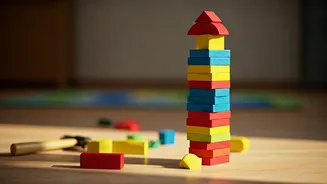
Creativity, often relegated to the status of an optional skill or misunderstood entirely, is in reality a cornerstone of healthy childhood development. When children engage in activities like constructing with blocks, simulating running a shop, crafting narratives, freely painting, or tackling open-ended problems, they are actively developing crucial life skills such as empathy, effective communication, adaptability, and sharp critical thinking. These are invaluable, lifelong competencies that cannot be replicated through rote memorization alone. A pedagogical approach centered on play and balance does not imply an absence of structure or academic rigor. Instead, it signifies a profound respect for a child's developmental readiness and stages. It involves integrating literacy and numeracy concepts through engaging, hands-on experiences rather than relying on abstract drills. This approach champions curiosity over blind conformity and encourages the asking of questions rather than the hasty pursuit of immediate answers. For instance, a child who learns mathematical principles through the practical act of cooking or constructing models internalizes these concepts far more deeply than one who engages in repetitive worksheet exercises. A collaborative storytelling session not only enhances language proficiency but also cultivates essential listening skills and bolsters self-confidence. Outdoor play, beyond its physical benefits, significantly sharpens problem-solving abilities and fosters vital social negotiation skills.
Shared Responsibility for Change
Transforming the landscape of childhood is a collective endeavor, extending far beyond the confines of schools. It necessitates a unified commitment from parents, educators, policymakers, and various institutions. Parents must actively resist the pervasive societal pressure of comparison, recognizing that each child progresses at their own unique pace. Instead of posing the question, 'Is my child ahead of the curve?', a more pertinent inquiry would be, 'Is my child happy, confident, and imbued with a sense of curiosity?' Creating dedicated screen-free time, fostering open dialogues about emotions, and diligently protecting unstructured time for free play are powerful acts of advocacy for our children's well-being. Educators require robust empowerment and specialized training to transition away from rote-learning systems. Their professional development should prioritize child psychology, the cultivation of social-emotional learning, and the implementation of developmentally appropriate practices. A classroom environment that celebrates mistakes as invaluable learning opportunities is essential for building resilience and nurturing a growth mindset. Furthermore, institutions and policymakers play a critical role by acknowledging that accelerating academic demands in early years does not yield superior learners; rather, it produces stressed individuals. Policies that advocate for reduced class sizes, integrated curricula that connect subjects, and comprehensive mental health support frameworks are indispensable for nurturing well-rounded children. Ultimately, childhood itself is not merely preparation for life; it *is* life. By safeguarding imagination and prioritizing well-being alongside academic learning, we are not lowering standards. Instead, we are cultivating capable, adaptable, and resilient human beings. The future will undoubtedly belong to those who possess the ability to think critically, collaborate effectively, and innovate with confidence, rather than solely to those who can memorize at the highest speed. Reimagining childhood is not an act of regression; it is a forward-looking approach rooted in wisdom, ensuring that in our quest for achievement, we do not diminish the inherent wonder that defines the experience of being a child.