







Why Start with?
For those just starting out in astronomy, binoculars present an excellent choice. Telescopes, while powerful, can be complex to set up and use. Binoculars,
on the other hand, are user-friendly, lightweight, and portable. They offer a wide field of view, allowing you to easily scan the night sky and locate celestial objects. This makes them perfect for learning constellations and observing larger objects like the Moon and brighter planets. They are also significantly less expensive than telescopes, providing an affordable way to explore the cosmos. The simplicity of binoculars encourages casual stargazing, making it an accessible and enjoyable hobby for beginners.
Choosing the Right
When selecting binoculars for stargazing, consider a few key specifications. The magnification and objective lens diameter are crucial. A common configuration for beginners is 7x50 or 10x50. The first number (e.g., 7 or 10) indicates the magnification, while the second (e.g., 50) represents the diameter of the objective lens in millimeters. Higher magnification allows you to see more details, but it also narrows your field of view. A larger objective lens gathers more light, resulting in brighter images, which is essential for viewing faint objects. Other important features include the type of prism (Porro or roof), eye relief, and weather resistance. Porro prisms are often considered to offer better image quality, but roof prisms tend to be more compact. Eye relief is particularly important for eyeglass wearers. Waterproof or water-resistant binoculars can protect against the elements.
What to Expect
Binoculars open up a world of celestial objects to observe. The Moon is a prime target, revealing craters, mountains, and valleys in great detail. Planets like Jupiter and Saturn can also be identified; you might see Jupiter's four largest moons or Saturn's rings under good viewing conditions. Open star clusters, such as the Pleiades and the Hyades, are stunning sights, appearing as sparkling jewels against the dark sky. The Milky Way becomes a rich tapestry of stars and nebulae. Binoculars provide a wider field of view compared to telescopes, making it easier to locate objects. Be aware that the images you see will be upright, but not inverted, unlike what you might see through some telescopes. Plan your viewing sessions by consulting a star chart or a stargazing app to find interesting objects.
Tips for Beginners
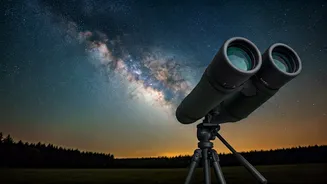
To get the most out of your binocular stargazing, follow these tips. Choose a location away from city lights to minimize light pollution. Allow your eyes to adapt to the darkness for at least 20-30 minutes before starting. Use a stable position, such as leaning against a wall or using a monopod or tripod, to reduce shakiness. Start with brighter and easier-to-find objects, gradually working your way toward fainter targets. Practice focusing on distant objects during the day to familiarize yourself with your binoculars. Keep a notebook to record what you see. Join a local astronomy club or online forum to learn from experienced observers and get recommendations for interesting targets to observe. Remember, stargazing is a process of learning and discovery; enjoy the journey!