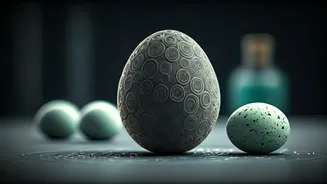








Engineering Life's Cradle
The humble eggshell is a marvel of natural engineering, far more than just a container. It actively manages vital gas exchange, controls moisture levels,
and provides essential physical protection for the developing embryo. Recreating this intricate functionality in a manufactured substitute demanded sophisticated engineering, focusing on precise control of porosity, shell thickness, and the material's thermal properties. The artificial shells developed in this experiment were meticulously crafted to mirror the complex calcium carbonate microstructure found in natural avian eggs. This allowed for the crucial diffusion of carbon dioxide outward and oxygen inward, at rates closely matching those of a living egg. Furthermore, the synthetic reproduction of internal membrane layers, which are critical for regulating humidity and preventing bacterial contamination, was essential to the success of the project. Achieving the correct balance of these parameters was the deciding factor in enabling embryonic development to progress successfully, transforming a mere replica into a viable incubator.
A Lifeline for Conservation
For initiatives focused on de-extinction and the breeding of critically endangered avian species, securing fertile eggs remains a significant hurdle. Natural eggs are inherently delicate, posing considerable challenges for transportation and are, by their very nature, irreplaceable. The development of an artificial incubation vessel capable of supporting a transferred embryo – or eventually, a synthesized one – offers reproductive biologists unprecedented flexibility. This technology could revolutionize the management of genetic resources across vast geographical distances. The domestic chicken served as an ideal initial test subject due to its well-understood embryology and relatively short incubation period, around 21 days. Adapting this technique to larger or more taxonomically diverse birds, such as the California condor or various crane species, would necessitate highly specific calibration of every physical parameter involved, as eggshell porosity, for instance, varies considerably across different bird families. It is also important to acknowledge potential risks, including subtle variations in temperature or humidity within artificial incubation environments that could lead to developmental issues not immediately apparent at hatching, but potentially manifesting as physiological defects later in life. Comprehensive long-term health monitoring of chicks hatched through this method is still pending and will be crucial for establishing the reliability of this technique for species of conservation concern.
Precision Manufacturing Meets Biology
The strategic selection of 3D printing for this endeavor is highly pertinent. Traditional manufacturing methods struggle to replicate the graded porosity and complex curved geometries characteristic of biological eggshells. Additive manufacturing processes, particularly those employing advanced ceramic or polymer composites, empower researchers to rapidly iterate on shell designs and rigorously test specific structural hypotheses without the need for expensive retooling. This level of precision fabrication is already a well-established practice in fields like orthopedic implants and microfluidic devices. Its application to reproductive biology follows a similar principle: creating functional interfaces with biological systems demands tolerances that can only be achieved through bespoke, custom manufacturing. This advancement in additive manufacturing offers a powerful new tool for reproductive biologists, enabling them to overcome previous limitations and push the boundaries of avian conservation and reproductive science.
Navigating the Future
Introducing animals hatched through artificial incubation into wild populations or established breeding programs will inevitably involve navigating a complex regulatory landscape. Wildlife agencies, both in the United States and Europe, mandate substantial evidence demonstrating developmental equivalence before captive-bred individuals can be integrated into managed populations. Consequently, any bird hatched from a printed egg would need to meet the same rigorous behavioral and physiological benchmarks as any other bird produced through conventional captive breeding. The prospect of de-extinction introduces an additional layer of intricacy. If the ultimate objective is to gestate embryos reconstructed from ancient DNA, as some pioneering startups have publicly stated, then the artificial egg represents merely one component within an exceptionally long and complex technical chain, each step of which carries its own set of uncertainties. For the present, the successful hatching of live chicks from fabricated shells stands as a significant and measurable engineering achievement. The company behind this innovation is positioning its technology as a versatile platform for both current conservation efforts and, looking further ahead, de-extinction applications. The ultimate success of these ambitious applications will hinge on the sustained performance of the underlying engineering principles when subjected to conditions far more demanding than those found in a typical chicken hatchery.