





The Open Door Advantage
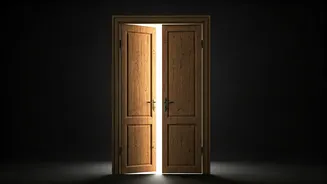
If your initial glance at the illusion registered the door as open, it suggests a personality eager to embrace new experiences and the unknown. This perspective
mirrors a mindset that views life as an unfolding narrative, where challenges and novel situations are met with enthusiasm rather than apprehension. Individuals who perceive the door as open often exhibit what's termed 'main character energy,' thriving on change and actively seeking growth. Psychologically, this aligns with high 'Openness to Experience' in personality models. Such people tend to be spontaneous, readily agreeing to new adventures, and are driven by a desire for continuous development, preferring action and forward momentum over stagnation. They are the ones who don't hesitate to take a chance, even if it means facing occasional stumbles.
The Closed Door Sanctuary
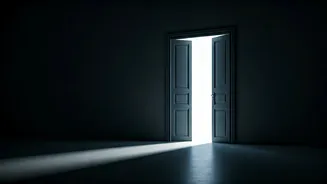
Conversely, if you first noticed the door as closed, it indicates a preference for a more controlled and private environment, a 'fortress of solitude.' This perception doesn't stem from fear but from a discerning approach to how one invests their limited time and energy. People who see a closed door often value deep introspection, structured planning, and clear personal boundaries. They are inclined to cultivate a close-knit circle of trusted individuals rather than accumulating numerous superficial acquaintances. The closed door represents a space for recharging and maintaining inner peace. In psychological terms, this often correlates with traits of conscientiousness or introverted resilience, prioritizing the establishment of a robust internal foundation before venturing into broader engagements. It signifies a readiness-focused approach to life's opportunities.
Brain's Choice Explained
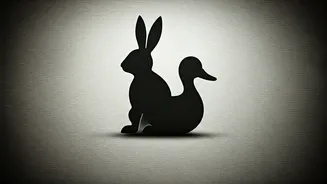
Your brain's interpretation of the ambiguous image—whether open or closed—is a fascinating demonstration of 'figure-ground organization,' a process where it resolves visual uncertainty. This split-second decision isn't arbitrary; it reflects your current psychological needs. Perceiving an open door prioritizes exploration and engagement with the external world, while seeing a closed door emphasizes security and inward focus. This mirrors how we navigate real-life transitions, constantly balancing contrasting elements. For instance, in diverse environments like India, one must adeptly navigate traditional customs and modern advancements, much like choosing whether to engage with the vibrant energy of a festival or the quietude of a personal ritual. Ultimately, neither interpretation is inherently superior; a life solely of open doors can lead to chaos, and a life of only closed doors can feel restrictive. True fulfillment lies in the ability to discern when to open up and when to maintain personal space.