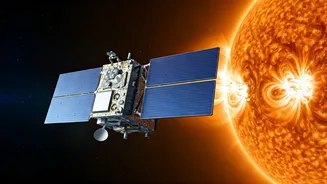







Cosmic Microscope Launched
The groundbreaking SNAPPY mission, humanity's first space-based neutrino observatory, has embarked on its orbital journey. This innovative detector, housed
within a compact 3U cubesat measuring approximately 12 inches in length and 4 inches in width, is designed to study neutrinos – fundamental particles that constantly stream through our universe. These elusive entities, born from nuclear processes within stars and other energetic cosmic events, are notoriously difficult to track. By deploying a detector into orbit, specifically at an altitude of 310 miles (500 kilometers), scientists aim to overcome the challenges of terrestrial detection and gain a clearer understanding of their origins. The SNAPPY spacecraft is expected to operate for roughly two years, gathering crucial data that could revolutionize our comprehension of solar physics and beyond. This launch represents a significant leap forward in our quest to probe the universe's most enigmatic phenomena.
Why Space for Neutrinos?
Detecting neutrinos on Earth presents a significant hurdle due to their extremely weak interactions with matter. To compensate for this, terrestrial neutrino observatories, such as China's Jiangmen Underground Neutrino Observatory buried 2,300 feet deep or the IceCube Neutrino Observatory at the South Pole, are colossal in scale and are situated far beneath the surface. This deep burial shields them from interfering cosmic radiation. However, the SNAPPY project, spearheaded by Wichita State University's Professor Nickolas Solomey, proposes a novel solution: leverage the abundance of neutrinos closer to their source. The sun emits neutrinos at a rate over a thousand times greater than what reaches Earth. By placing a compact, 1-kilogram detector like SNAPPY near the sun, its sensitivity can effectively match that of a much larger, Earth-based instrument. This space-based approach promises a more efficient and direct way to capture these elusive particles.
SNAPPY's Innovative Design
The SNAPPY detector distinguishes itself through its construction, featuring crystals made from gallium and tungsten. This composition offers enhanced sensitivity to neutrino impacts compared to the argon-based detectors commonly employed on Earth. The cubesat carrying SNAPPY, designed for a two-year mission at an altitude of 310 miles (500 kilometers), embarked on its journey on May 3 aboard a SpaceX CAS500-2 rideshare mission. The primary objective of SNAPPY is to rigorously test and validate the underlying technology for future, more ambitious neutrino detection missions. Professor Solomey's vision is to eventually deploy a neutrino detector in closer proximity to the sun. He believes that the gallium-based detector's exceptional sensitivity might even allow for the detection of less energetic neutrinos that typically evade terrestrial instruments, providing an unprecedented glimpse into the sun's internal workings.
Unveiling Solar Fusion
The implications of SNAPPY's success extend far beyond simply detecting neutrinos. By analyzing the immense flux of neutrinos streaming from the sun, researchers could unlock a unique window into the life-sustaining nuclear fusion processes occurring deep within its core. Neutrinos are born and escape the sun's core within seconds, providing a near-instantaneous snapshot of these energetic reactions. This is in stark contrast to photons, which can take up to 100,000 years to traverse the sun's interior to its surface. Professor Solomey likens this capability to having a 'microscope into the core of the sun.' Different fusion processes occur in distinct layers surrounding the solar core, and by studying the various types of neutrinos emitted, scientists could map and understand the intricate structure of the sun's fusion engine with unparalleled detail.